
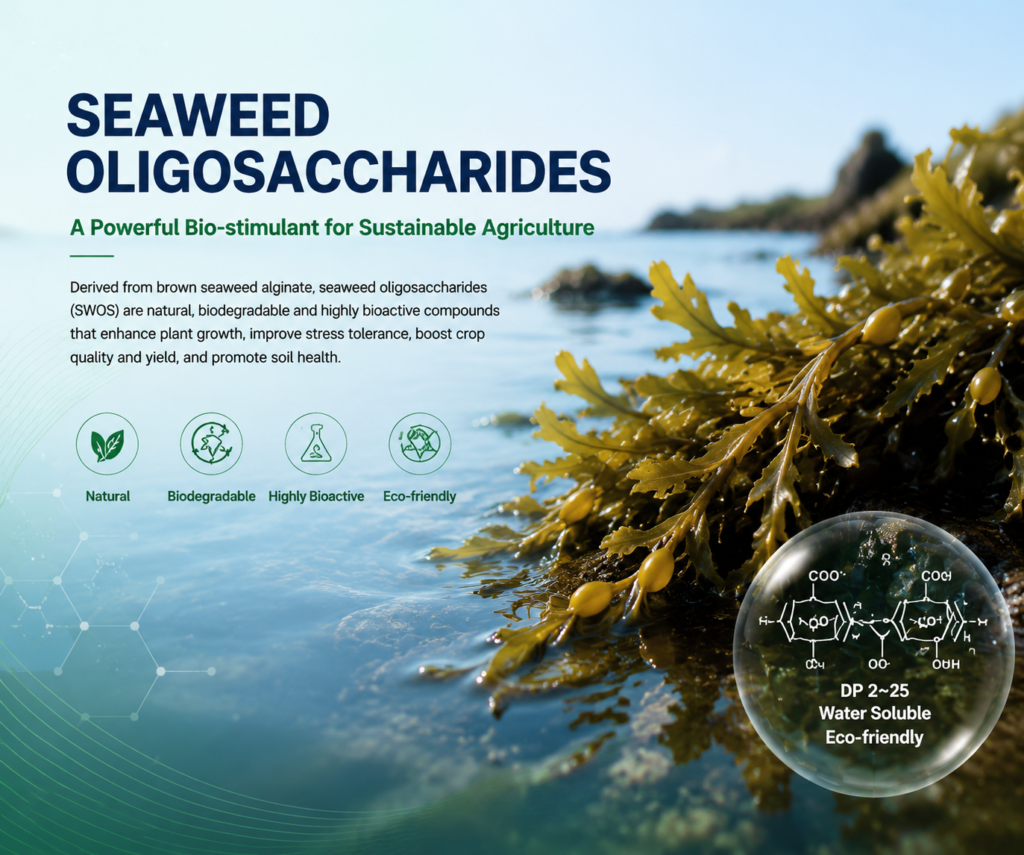
Harnessing the Power of Brown Algae Oligosaccharides as a Plant Biostimulant
Wellyou Tech – Advancing Sustainable Agriculture
Brown algae oligosaccharides (BAOs) are low-molecular-weight oligosaccharides, typically comprising 2–25 sugar units, produced through the depolymerization of brown algae polysaccharides. Depending on their uronic acid composition, BAOs can be classified as Mannuronic Acid Oligosaccharides (M-AOS), Guluronic Acid Oligosaccharides (G-AOS), or Heterogeneous Acid Oligosaccharides (H-AOS). With excellent water solubility and high bioactivity, BAOs have been proven to promote plant growth and enhance stress resistance.
1. Efficient and Eco-friendly Production
BAOs can be produced using enzymatic hydrolysis, fermentation, chemical, or physical methods. Among these, enzymatic hydrolysis—employing alginate lyases to depolymerize alginate—offers several advantages: mild reaction conditions, high catalytic efficiency, controllable substrate polymerization, and minimal environmental impact. Notably, BAOs obtained through enzymatic hydrolysis retain their full biological activity, making this method the preferred choice for industrial-scale production.
2. Applications of Algae Oligosaccharides in Plant Protection
BAOs demonstrate a broad spectrum of bioactivities in crop growth and health, serving as highly effective biostimulants.
Root Development Enhancement
Studies show that BAOs can promote root growth by upregulating nitrate reductase and auxin-related genes, increasing nitrate reductase activity, and facilitating auxin synthesis and transport. Recent research has documented significant root growth promotion across various crops, underlining BAOs’ potential as a natural growth enhancer.
Stress Resistance Improvement
Plants are constantly exposed to biotic and abiotic stresses, including drought, salinity, temperature extremes, pathogens, and oxidative stress. BAOs help mitigate these stresses by enhancing antioxidant enzyme activities, reducing reactive oxygen species accumulation, and protecting chlorophyll and photosynthetic systems, thereby boosting overall plant resilience.
Yield and Quality Enhancement
Field applications have shown remarkable results: rice treated with BAOs achieved a 13% yield increase, cauliflower demonstrated early- and mid-stage seed yield increases of 56.8% and 64.5%, respectively, and BAO treatment of strawberries improved flavonoid, particularly anthocyanin, biosynthesis in fruit.
Disease and Virus Resistance
BAOs not only possess direct antimicrobial activity but also induce systemic plant defenses. In rice, BAOs triggered accumulation of multiple phytoalexins, activating defense responses and reducing blast disease incidence by up to 39.06%. This highlights their role in sustainable disease management.
Nutritional Enhancement
BAOs can improve nutritional content by enhancing photosynthesis, inducing expression of biosynthetic genes, and increasing stomatal conductance, ensuring optimal CO₂ uptake. Different studies consistently report improved nutrient profiles in treated crops.
Antioxidant and Post-harvest Preservation
BAOs help extend post-harvest storage by increasing antioxidant capacity, maintaining fruit firmness, and reducing decay. For instance, kiwifruit treated with BAOs exhibited increased hardness and reduced grey mold incidence.
Soil Microbial Diversity Enhancement
BAOs positively influence rhizosphere microbial communities. Wheat roots irrigated with BAOs showed increased abundance of acidophilic bacteria, Simplicispira, and nitrogen-fixing Azospira species, enhancing soil nutrient transformation and overall fertility.
3. Fertilizer Efficiency Enhancement
The carboxyl groups in BAOs can chelate ammonium and ammonia nitrogen from fertilizers, forming complexes that slow nitrogen release and reduce conversion to nitrate and nitrite, minimizing nutrient loss and improving fertilizer utilization. Additionally, BAOs can be incorporated with various biomass materials to develop controlled-release fertilizer coatings, extending nutrient availability while enhancing soil water retention.
With their unique molecular structure and diverse bioactivities, brown algae oligosaccharides are emerging as a powerful tool in sustainable agriculture. Continued research into their mechanisms and production optimization will further unlock their potential, supporting higher crop yields, improved quality, and environmentally friendly farming practices.
Explore Wellyou Tech’s portfolio of advanced biostimulants and discover how we can help you cultivate healthier, more resilient crops.