
1. Introduction of Sodium Gluconate
Sodium gluconate is the sodium salt of gluconic acid, typically produced through the fermentation of glucose. Known for its excellent chelating ability, biodegradability, and environmental safety, sodium gluconate has been widely used in industries such as construction, food, and pharmaceuticals.
In recent years, with the growing demand for sustainable and efficient agricultural inputs, sodium gluconate has attracted increasing attention in the agrochemical and fertilizer sectors. Its multifunctional properties make it a promising additive in modern agriculture.
2. Chemical Properties and Advantages
- Chemical formula: C₆H₁₁NaO₇
- Molecular weight: 218.14
- Solubility: Highly soluble in water
- pH: Neutral to slightly alkaline
Key Advantages:
- Strong chelating agent for metal ions (Ca²⁺, Mg²⁺, Fe³⁺, Zn²⁺)
- Excellent compatibility with fertilizers and agrochemicals
- Biodegradable and environmentally friendly
- Non-toxic and safe for crops and soil
- High stability across a wide pH range
3. Mechanisms of Action in Agriculture
3.1 Chelation and Nutrient Availability
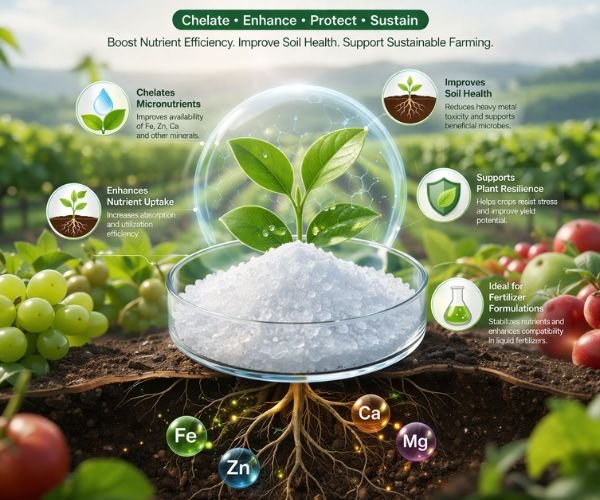
Sodium gluconate acts as an effective chelating agent, forming stable complexes with micronutrients such as iron, zinc, and calcium. This helps:
- Prevent nutrient precipitation in soil or solution
- Improve nutrient solubility and mobility
- Enhance plant uptake efficiency
Compared with traditional chelating agents (e.g., EDTA), sodium gluconate offers better biodegradability and lower environmental impact.
3.2 Soil Conditioning and Remediation
Sodium gluconate can improve soil conditions by:
- Reducing heavy metal toxicity through complexation
- Enhancing microbial activity due to its biodegradable nature
- Improving soil structure indirectly
It is especially useful in:
- Saline-alkali soils
- Heavy metal-contaminated soils
3.3 Synergistic Effects with Fertilizers
When used in fertilizer formulations, it can:
- Improve nutrient stability in liquid fertilizers
- Prevent crystallization or sedimentation
- Enhance compatibility in multi-nutrient systems (NPK + trace elements)
This makes it particularly suitable for:
- Liquid fertilizers
- Foliar sprays
- Fertigation systems
3.4 Enhancement of Plant Stress Resistance
Sodium gluconate contributes indirectly to plant stress tolerance by:
- Improving nutrient balance under stress conditions
- Supporting beneficial microbial populations
- Reducing oxidative stress through improved mineral nutrition
4. Application Methods of Sodium Gluconate
4.1 Foliar Application
- Acts as a carrier and chelating agent for micronutrients
- Enhances leaf absorption efficiency
4.2 Soil Application / Fertigation
- Improves nutrient availability in the rhizosphere
- Reduces nutrient fixation in soil
4.3 Fertilizer Formulation Additive
- Used in liquid or water-soluble fertilizers
- Improves product stability and shelf life
5. Recommended Dosage
Typical usage depends on formulation and application method:
- Foliar spray: 0.05% – 0.2% solution
- Fertigation: 1–3 kg/ha per application
- Formulation additive: 0.5% – 2% in liquid fertilizers
(Exact dosage should be adjusted based on crop type and soil conditions.)
6. Compatibility and Safety
- Compatible with most fertilizers and agrochemicals
- Stable under a wide pH range
- Safe for crops when used at recommended rates
- Fully biodegradable, leaving no harmful residues
7. Market Potential and Future Outlook
With the increasing shift toward sustainable agriculture and environmentally friendly inputs, sodium gluconate is gaining importance as a green chelating agent and functional additive.
Its advantages over traditional chelators include:
- Lower environmental persistence
- Cost-effectiveness
- Multifunctionality
It is expected to play a larger role in:
- Biostimulant formulations
- Organic agriculture inputs
- High-efficiency fertilizer systems
Sodium gluconate is more than just an industrial chemical—it is a versatile and eco-friendly component with significant potential in agriculture. Its ability to enhance nutrient availability, improve soil conditions, and support sustainable farming practices makes it a valuable ingredient in modern fertilizer and biostimulant formulations.