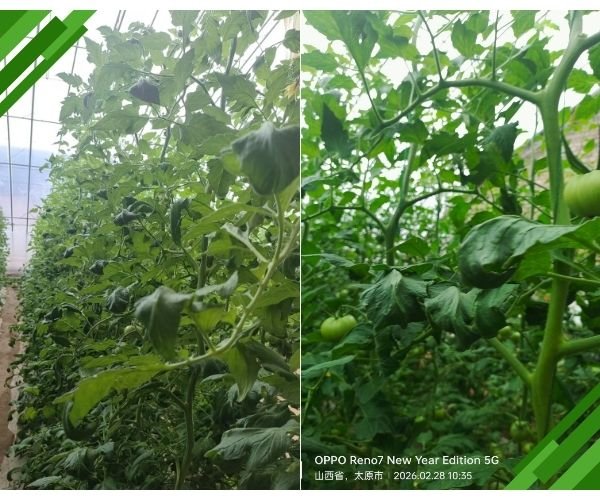
Leaf curling in greenhouse-grown Tomato during the mid-growth stage is a frequent but often misdiagnosed issue. While nutrient deficiencies are commonly suspected, this case study demonstrates that phytotoxicity caused by excessive application of plant growth regulators (PGRs) and foliar inputs can be the primary factor.
This study analyzes field symptoms, identifies the root cause, and provides a scientifically grounded recovery strategy to restore normal plant growth.
1. Field Background
- Crop: Tomato (greenhouse cultivation)
- Growth Stage: mid-growth stage(vegetative to early reproductive transition)
- Location: Northern China (typical protected cultivation system)
- Management Practice: Frequent foliar spraying (PGRs + nutrient solutions)
2. Symptom Description
Observed abnormalities included:
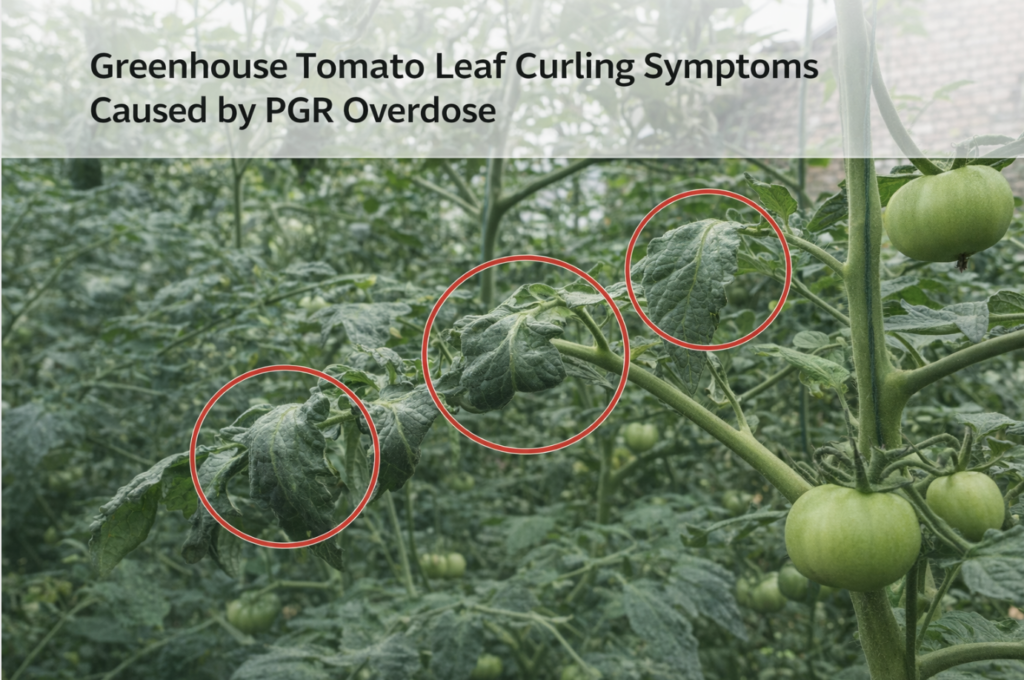
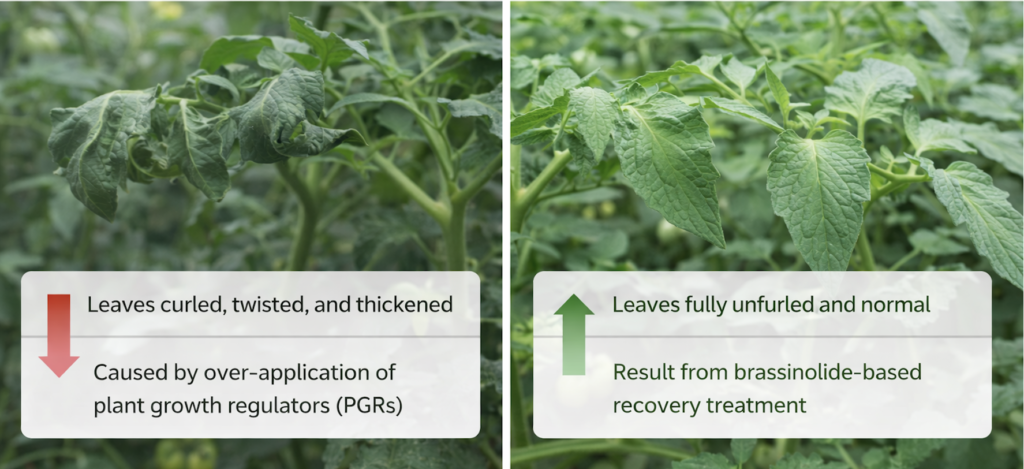
- Moderate to severe leaf curling (epinasty and distortion)
- Thickened, dark green leaves with reduced leaf expansion (expansion capacity)
- Deformed young leaves near the growing point
- No interveinal chlorosis or necrosis (rules out classic deficiencies)
- Uniform distribution across treated areas (non-pathogenic pattern)
📌 These characteristics indicate a physiological disorder rather than a biotic disease or simple nutrient deficiency.
3. Differential Diagnosis
| Potential Cause | Likelihood | Reason |
|---|---|---|
| Calcium deficiency | Low | No tip burn or necrosis |
| Boron deficiency | Low | No brittle or cracked tissues |
| Viral infection | Low | No mosaic or patchy spread |
| Environmental stress | Medium | Could contribute but not primary |
| Chemical phytotoxicity (PGR/foliar spray) | High | Matches uniform distortion + management history |
4. Root Cause Analysis
4.1 Primary Cause: Over-application of Plant Growth Regulators
Excessive or improper use of PGRs disrupts endogenous hormone balance, particularly:
- Auxins (IAA)
- Cytokinins
- Gibberellins
This imbalance leads to:
- Abnormal cell elongation
- Uneven tissue growth rates
- Distorted leaf morphology
4.2 Contributing Factors
- High concentration or repeated spraying
- Tank mixing multiple agrochemicals
- Insufficient interval between applications
- Enhanced absorption under greenhouse conditions (high humidity, low الضوء强度)
5. Physiological Mechanism
Phytotoxicity from excessive foliar inputs causes:
- Hormonal disequilibrium → abnormal signal transduction
- Cell division disorder → malformed leaf primordia
- Osmotic stress at tissue level → leaf curling and thickening
- Temporary inhibition of normal metabolic pathways
Unlike nutrient deficiencies, this condition primarily affects growth regulation rather than nutrient availability.
6. Corrective Measures
6.1 Immediate Action: Detoxification and Recovery
Apply brassinosteroids (Brassinolide) via foliar spray:
- Enhances plant stress resistance
- Regulates endogenous hormone balance
- Promotes repair of damaged tissues
Recommended approach:
- Low concentration foliar spray
- 1–2 applications at 5–7 day intervals
6.2 Agronomic Adjustments
- Suspend PGR applications temporarily
- Avoid complex tank mixes
- Increase interval between foliar sprays
- Apply during mild environmental conditions (avoid high ताप/strong sunlight)
6.3 Nutritional Support
Provide balanced nutrition to support recovery:
- Calcium (Ca) → cell wall stability
- Magnesium (Mg) → photosynthesis
- Trace elements → enzyme activation
Optional support:
7. Recovery Observation
After implementing corrective measures:
- 3–5 days: Reduction in new leaf deformation
- 5–7 days: Emergence of normal leaves
- 10–14 days: Full recovery of growth vigor
Existing curled leaves typically do not recover, but new growth serves as the key indicator.
8. Key Insights for Growers
- Not all leaf curling is nutrient-related
- Overuse of agrochemicals is a hidden but common cause
- Greenhouse environments amplify phytotoxic risks
- Precision in dosage and spray interval is critical
This case highlights that physiological disorders caused by improper agrochemical use can closely mimic nutrient deficiencies. Accurate diagnosis is essential to avoid misapplication of fertilizers and further stress.
Timely intervention using plant recovery regulators such as brassinolide, combined with optimized management practices, ensures rapid restoration of healthy growth in greenhouse tomatoes.