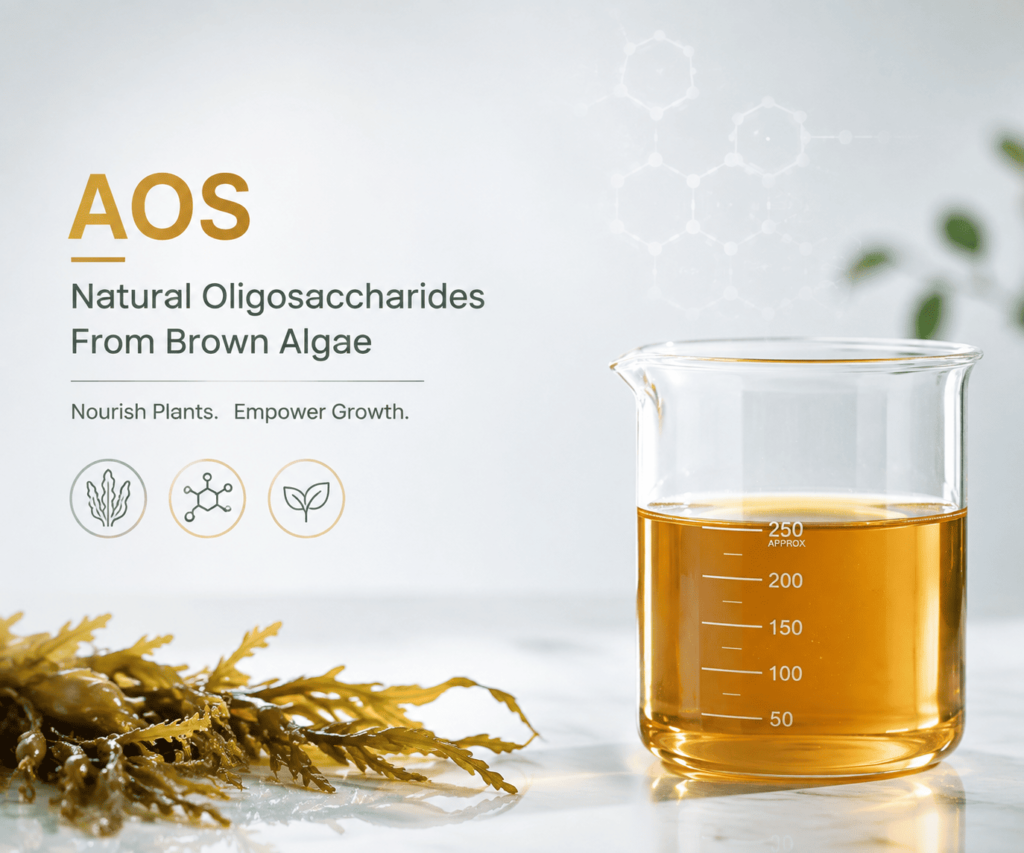
Alginate oligosaccharides (AOS), also known as brown algae oligosaccharides, have gained increasing attention in modern agriculture due to their excellent biostimulant properties. They are widely used in crop nutrition, stress management, root development, and plant growth regulation.
Recently, we received a question from a customer regarding the dissolution performance of AOS powder:
“Does alginate oligosaccharide dissolve quickly in water? Why does it need stirring and hydration time?”
This is a very common question when customers first use natural oligosaccharide products. In this article, we will explain the dissolution characteristics of AOS and provide practical dissolution guidance based on our application experience.
1. Why Does Alginate Oligosaccharide Behave Differently from Ordinary Fertilizers?
Many conventional fertilizers, such as potassium nitrate, potassium sulfate, or magnesium sulfate, are inorganic salts. They dissolve rapidly in water because their ionic structures easily separate into soluble ions.
However, Alginate oligosaccharides (AOS) are natural bioactive compounds derived from alginate extracted from brown algae. Their molecular structure is based on oligosaccharide chains.
Because of this natural structure:
- AOS requires a hydration process;
- The molecules need time to interact with water;
- Complete dispersion may require continuous stirring.
Therefore, AOS dissolution behavior is different from traditional mineral fertilizers.
A slower dissolution process does not mean poor quality. It is a natural characteristic of bio-based oligosaccharides.
2. What Happens When AOS Powder Is Added into Water?
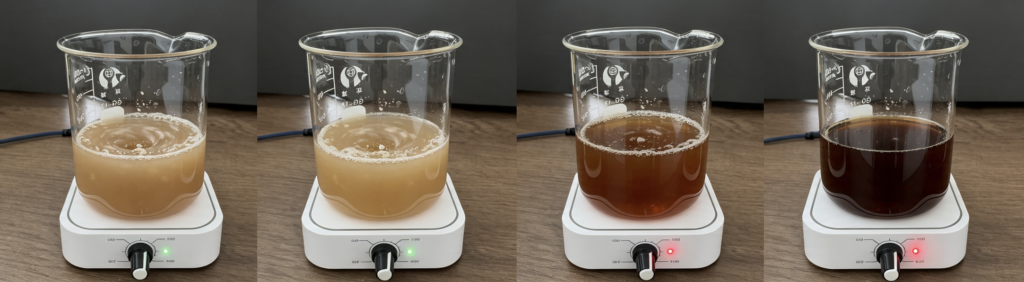
When Alginate oligosaccharide powder is first added into water, several stages may occur:
Stage 1: Wetting
The powder particles contact water and begin absorbing moisture.
Stage 2: Hydration
Water molecules penetrate into the oligosaccharide structure, allowing the particles to gradually disperse.
Stage 3: Complete Dispersion
With sufficient stirring time, AOS becomes evenly distributed in the solution.
During this process, users may observe:
- Temporary floating particles;
- Small agglomerates;
- Slight turbidity.
These phenomena are normal for natural oligosaccharide products.
3. Recommended Dissolution Procedure for Alginate Oligosaccharides (AOS)
To achieve the best dissolution performance, we recommend the following steps:
Step 1: Prepare clean water
Use clean water with suitable temperature.
(Generally, room temperature water is acceptable.)
Step 2: Add water first
Always add water into the mixing tank before adding AOS powder.
Step 3: Slowly add AOS powder
Add the powder gradually while maintaining continuous stirring.
Avoid adding a large amount of powder at one time, as this may cause temporary clumping.
Step 4: Continue stirring
Keep stirring for approximately:
10–15 minutes or longer depending on concentration and equipment.
Step 5: Allow hydration time if necessary
For higher concentration solutions, allowing additional standing time can improve dispersion.
Before application, mix again to ensure uniformity.
4. Customer Case: Solving AOS Dissolution Concerns in Thailand
A customer from Thailand recently raised a question about the dissolution speed of Alginate oligosaccharides.
After reviewing the application process, we explained that AOS is different from conventional fertilizers. Due to its natural oligosaccharide structure, it requires sufficient stirring and hydration time.
We provided detailed dissolution instructions:
- Add water first;
- Slowly add AOS powder;
- Maintain continuous stirring;
- Allow enough hydration time.
After adjusting the dissolution method, the customer could better understand the characteristics of this natural biostimulant product.
This case also reminds us that technical guidance is an important part of supplying high-quality agricultural solutions.
5. How to Improve the Application Effect of AOS?
Besides correct dissolution, the following factors also influence application performance:
Water quality
Very hard water may affect dispersion performance.
Concentration
Higher concentration solutions usually require longer mixing time.
Mixing equipment
Mechanical stirring provides better dispersion compared with manual mixing.
Compatibility
Before mixing Alginate oligosaccharides with other fertilizers or pesticides, a small compatibility test is recommended.
Alginate oligosaccharides are natural biostimulants with unique molecular characteristics. Unlike traditional mineral fertilizers, they require proper hydration and mixing to achieve complete dispersion.
Understanding the correct dissolution method helps users maximize the benefits of AOS in agricultural applications.
At Wellyhou Tech, we not only provide high-quality biostimulant products but also offer professional technical support to help customers achieve better application results.
FAQ
Q: Does AOS dissolve immediately in water?
A: AOS can disperse well in water, but complete dissolution requires sufficient stirring and hydration time due to its natural oligosaccharide structure.
Q: Is slow dissolution a quality problem?
A: No. The dissolution behavior is related to the natural molecular structure of oligosaccharides and does not indicate poor quality.
Q: Can AOS be used in drip irrigation and foliar application?
A: Yes. After proper dissolution and filtration if necessary, AOS can be applied through different agricultural systems.