
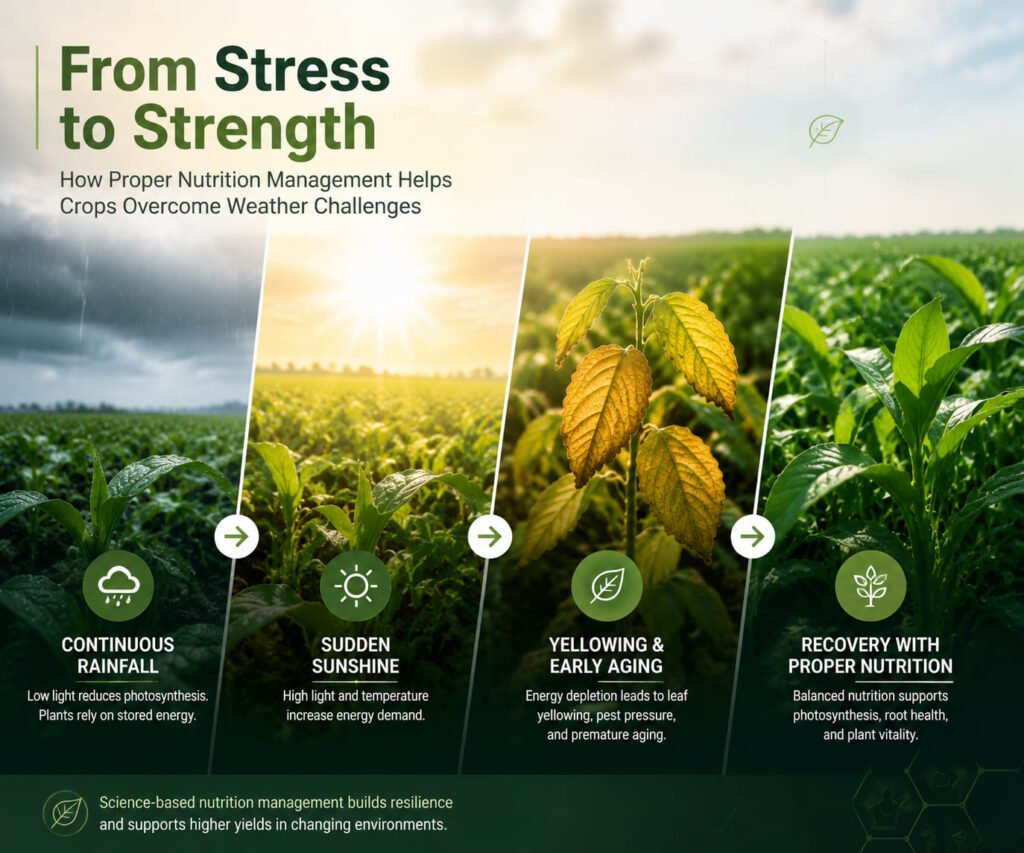
In many agricultural regions, growers often observe a confusing phenomenon after a period of continuous cloudy and rainy weather:
Crops look healthy during the low-light period, but after several days of sunshine and rising temperatures, leaves suddenly turn yellow, plants become weak, and premature aging occurs. Meanwhile, pest and disease pressure often increases rapidly.
Many growers initially consider it a disease problem and apply pesticides repeatedly, but the symptoms remain unresolved.
The real cause is often physiological stress caused by energy imbalance.
Continuous low light followed by sudden strong sunlight creates a chain reaction inside plants, affecting photosynthesis, carbohydrate metabolism, root activity, and stress resistance.
Understanding this mechanism is essential for developing effective crop management strategies.
1. Why Do Crops Age Prematurely After Continuous Rain Followed by Sunshine?
The problem is not simply “sunburn”. It is a physiological imbalance caused by the interaction between insufficient energy production and excessive energy consumption.
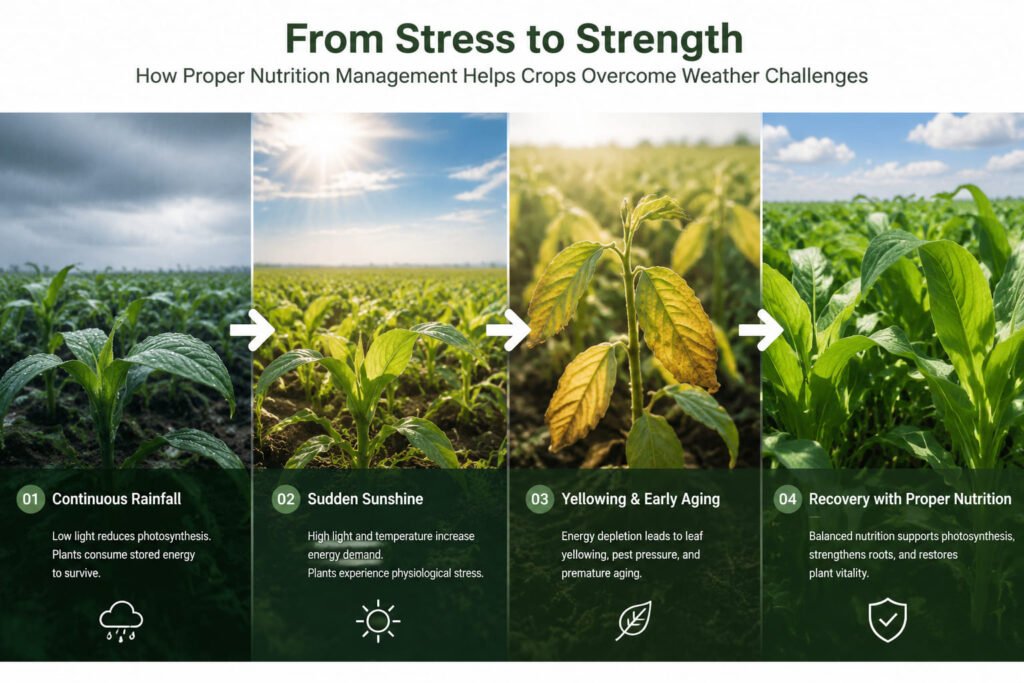
The process usually develops through four stages.
Stage 1: Continuous Cloudy Weather Depletes Plant Energy Reserves
During long periods of insufficient sunlight, photosynthesis is significantly reduced.
Plants cannot produce enough carbohydrates, including glucose, sucrose, and polysaccharides, while respiration continues 24 hours a day and keeps consuming stored energy.
At the same time:
- Root activity decreases under weak light conditions
- Water and nutrient uptake capacity decline
- Leaves become thinner and more sensitive
- Plant stress resistance gradually decreases
In simple terms:
During prolonged cloudy weather, crops consume more energy than they produce, gradually entering an energy-deficit state.
Stage 2: Sudden Strong Sunlight Accelerates Energy Consumption
When sunlight suddenly returns, plants face a new challenge.
After continuous low-light conditions, leaves are not fully prepared for high radiation and temperature.
Under strong sunlight:
- Leaf stomata may close rapidly to reduce water loss
- Carbon dioxide absorption decreases
- Photosynthetic efficiency drops
- High temperature stimulates respiration and increases carbohydrate consumption
The result is an imbalance:
Energy consumption exceeds energy production, causing rapid depletion of carbohydrate reserves.
Stage 3: Protein Breakdown Causes Yellow Leaves and Pest Pressure
When carbohydrate reserves become insufficient, plants activate survival mechanisms.
To maintain basic metabolism, plants begin breaking down internal proteins and other stored compounds.
This process leads to:
- Chlorophyll degradation
- Rapid leaf yellowing
- Reduced photosynthetic capacity
Meanwhile, weakened plants often become more attractive to sucking pests such as:
- Spider mites
- Thrips
- Whiteflies
At the same time, young leaves developed under weak light conditions have poor tolerance to strong sunlight, increasing the risk of leaf scorching and irreversible damage.
Stage 4: Root Decline Creates a Negative Growth Cycle
After sunny weather returns, leaf transpiration increases rapidly.
However, roots weakened by prolonged cloudy conditions cannot supply water fast enough.
This results in:
- Physiological wilting
- Reduced nutrient absorption
- Root aging and fine root loss
- Lower photosynthetic recovery ability
Eventually, the plant enters a cycle:
Weak roots → insufficient nutrient supply → weaker leaves → lower photosynthesis → further root decline
leading to premature aging and yield loss.
2. Practical Strategies to Prevent Post-Rainfall Crop Stress
Based on field observations, preventing this problem requires improving plant energy balance, root activity, and stress adaptation.
1. Maintain Photosynthetic Nutrition and Carbohydrate Storage
During extended cloudy periods, plants need additional nutritional support to maintain metabolic activity.
Applying functional foliar nutrition combined with essential micronutrients can help:
- Maintain photosynthetic efficiency under low light
- Support carbohydrate accumulation
- Improve leaf vitality
- Prepare crops for sudden environmental changes
The key principle is:
Store sufficient energy before stress occurs, rather than waiting until plants show symptoms.
2. Adjust Water and Nitrogen Management
During continuous rainy weather:
Excess irrigation and excessive nitrogen application should be avoided.
Recommended practices:
- Use moderate irrigation instead of heavy watering
- Maintain healthy root oxygen conditions
- Reduce unnecessary nitrogen input
Nitrogen assimilation requires significant energy from plants. Under low-light conditions, excessive nitrogen can increase metabolic pressure and accelerate carbohydrate depletion.
3. Control Excessive Vegetative Growth
Low-light conditions often stimulate weak and elongated growth.
Excessive shoots and leaves increase respiratory consumption and compete for limited energy.
Proper growth regulation can help:
- Reduce unnecessary nutrient consumption
- Improve plant balance
- Maintain stronger stress resistance
Growth regulators should always be adjusted according to crop type, growth stage, and environmental conditions.
4. Provide a Buffer Period Before Strong Sunlight
Plants need time to adapt from low-light conditions to high radiation.
Greenhouse crops:
Before strong sunlight arrives:
- Use shading measures for several hours
- Allow leaves to gradually adapt to higher light intensity
- Reduce sudden photosynthetic stress
Open-field crops:
During the early stage of sunny weather:
- Maintain proper humidity around plants
- Reduce excessive leaf temperature
- Help plants recover stable transpiration
A gradual transition can significantly reduce physiological damage.
Wellyou Tech’s Perspective: Supporting Crop Resilience Through Plant Nutrition
Field experience shows that premature aging after continuous rainfall is usually not caused by a single disease.
It is a physiological stress response caused by energy imbalance, weakened roots, and insufficient nutrient metabolism.
Effective crop management should focus on:
Before stress:
Building stronger energy reserves and maintaining balanced nutrition.
During stress:
Reducing unnecessary consumption and protecting plant metabolism.
After stress:
Supporting recovery of photosynthesis and root activity.
At Wellyou Tech, we focus on providing functional fertilizer and biostimulant solutions that help crops maintain better resilience under changing environmental conditions.
Through scientific nutrition management, growers can better protect crop performance and achieve more stable production in increasingly unpredictable climates.