
Introduction: What Does Polyglutamic Acid Really Do in Agriculture?
In recent years, Polyglutamic Acid (PGA) has become one of the most discussed functional ingredients in the agricultural industry. It is widely used in high-end water-soluble fertilizers, compound fertilizers, and biostimulant products.
Many growers have noticed that fertilizers containing PGA are often positioned as premium products. The reason is not only marketing value, but also the unique properties of this natural polymer.
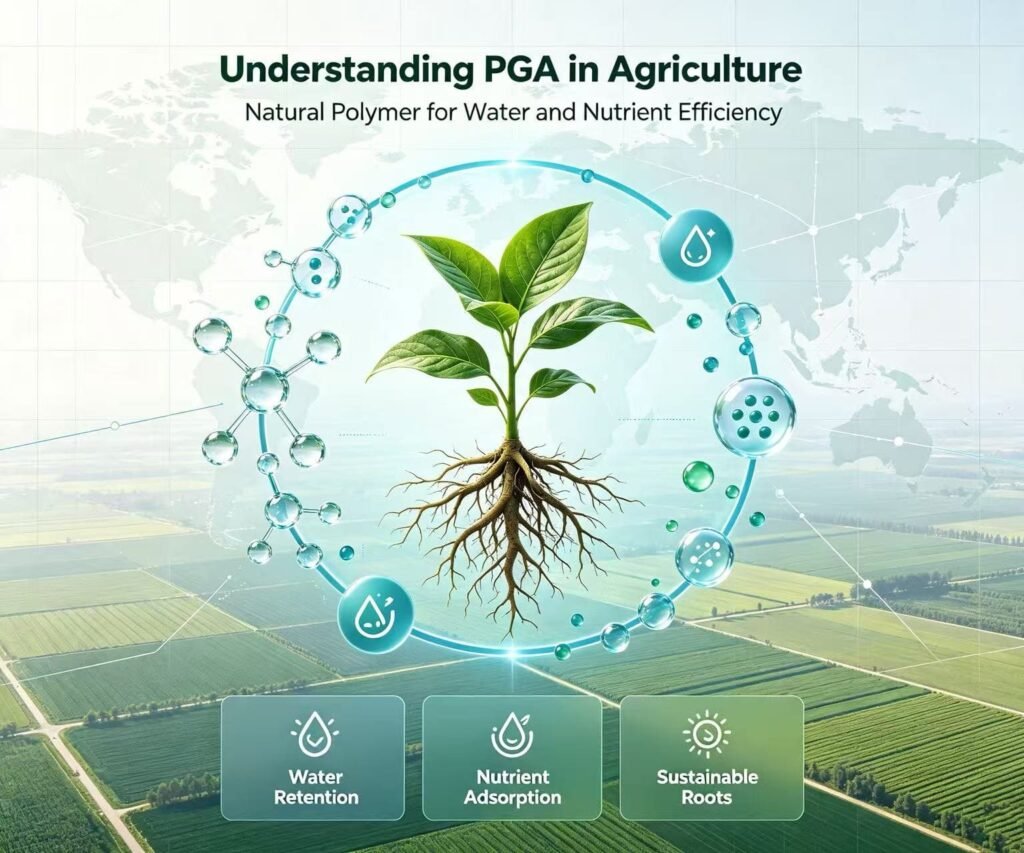
When PGA granules are added into water, they can rapidly absorb water and form a transparent gel-like structure. This simple demonstration shows one of its most important characteristics: strong water retention ability.
However, a scientific understanding of PGA is essential.
Polyglutamic Acid is not a “magic solution” for every soil problem. Its real value lies in improving water and nutrient management efficiency, especially under conditions where water loss and nutrient leaching are major challenges.
What Is Polyglutamic Acid (PGA)?
Polyglutamic Acid (PGA), also known as γ-Polyglutamic Acid (γ-PGA), is a natural biodegradable polymer produced through microbial fermentation.
Unlike traditional fertilizers that directly supply nutrients, PGA works as a functional agricultural biostimulant.
Its molecular structure contains numerous hydrophilic groups and negatively charged functional groups, giving it several unique properties:
- Excellent water absorption capacity;
- Strong moisture retention ability;
- Nutrient adsorption capacity;
- Biodegradable and environmentally friendly characteristics.
Because of these properties, PGA has attracted increasing attention in modern agriculture, especially in water-saving farming systems.
How Does Polyglutamic Acid Work in Agriculture?
1. Improving Soil Water Retention
The most recognized function of PGA is its ability to retain water.
When PGA comes into contact with water in the soil, its long molecular chains expand and form a three-dimensional network structure. This structure works like a microscopic water reservoir, capturing and holding water around the root zone.
This mechanism helps:
- Reduce rapid water loss;
- Maintain more stable soil moisture;
- Improve irrigation efficiency;
- Support crop growth under water-limited conditions.
Therefore, PGA is particularly valuable in:
- Sandy soils with poor water-holding capacity;
- Dry and semi-arid regions;
- Areas with limited irrigation resources;
- High-value crop production systems.
2. Improving Nutrient Retention and Fertilizer Efficiency
Besides water retention, PGA can also influence nutrient movement in soil.
The molecular chains of PGA contain abundant carboxyl groups, which can interact with positively charged nutrient ions, including:
- Ammonium nitrogen (NH₄⁺);
- Potassium ions (K⁺);
- Calcium ions (Ca²⁺);
- Magnesium ions (Mg²⁺).
By temporarily retaining these nutrients around the root zone, PGA can help reduce nutrient losses caused by excessive water movement and improve fertilizer utilization efficiency.
This is why PGA is commonly incorporated into:
- Water-soluble fertilizers;
- Compound fertilizers;
- Micronutrient fertilizers;
- Controlled-release fertilizer formulations.
PGA Is Not a Replacement for Soil Structure Improvement
One common misunderstanding about PGA is that it can completely solve soil compaction and poor soil structure.
In reality, PGA has a clear functional position.
Its main role is:
Water retention + Nutrient management + Root zone moisture regulation
However, PGA is not:
- A permanent soil skeleton material;
- A substitute for organic matter;
- A complete solution for severely compacted soils.
Healthy soil requires a balanced structure, including:
- Water-holding pores;
- Air-filled pores;
- Stable soil aggregates;
- Active microbial communities.
If soil is already highly compacted, heavy clay, or poorly drained, improving soil structure requires comprehensive management strategies, such as:
- Increasing organic matter;
- Improving soil aggregation;
- Applying suitable microbial solutions;
- Using proper soil amendments.
PGA should be considered as part of an integrated soil management program rather than a single solution.
Where Is Polyglutamic Acid Most Suitable for Application?
1. Sandy and Light-Textured Soils
Sandy soils often have:
- Low water retention;
- Fast nutrient movement;
- Higher risk of fertilizer loss.
PGA can help improve moisture availability and nutrient retention around plant roots.
2. Drought-Prone Agricultural Areas
In regions facing irregular rainfall or limited irrigation, PGA can support more efficient water management by extending soil moisture availability.
3. High-Value Crops
PGA is widely applied in crops with high economic value, including:
- Vegetables;
- Fruits;
- Greenhouse crops;
- Flowers and ornamental plants.
By improving the root-zone environment, PGA helps create better conditions for efficient nutrient uptake.
How to Use PGA More Effectively?
The best results come from combining PGA with a complete crop nutrition strategy.
Recommended approaches include:
Combine PGA with Balanced Fertilization
PGA works best when used together with appropriate NPK fertilizers and micronutrients.
Combine PGA with Soil Health Management
For long-term soil improvement, PGA should be integrated with:
- Organic fertilizers;
- Humic substances;
- Beneficial microorganisms;
- Soil conditioners.
Apply According to Soil and Crop Conditions
Different soils and crops require different application strategies. The appropriate dosage and timing should be determined based on:
- Soil type;
- Climate conditions;
- Irrigation system;
- Crop growth stage.
The Correct Understanding of Polyglutamic Acid
Every agricultural input has its own specific role.
The real value of Polyglutamic Acid is not that it replaces all other solutions, but that it provides a unique approach to improving agricultural efficiency through its natural polymer characteristics.
PGA helps agriculture by:
- Retaining valuable moisture;
- Reducing nutrient losses;
- Improving fertilizer utilization;
- Supporting a healthier root-zone environment.
When combined with proper crop nutrition and soil management practices, PGA becomes a powerful tool for sustainable agriculture.
Wellyou Tech: Your Partner in Agricultural Biostimulant Solutions
At Wellyou Tech, we focus on providing reliable agricultural solutions for global fertilizer companies, distributors, and growers.
Our biostimulant portfolio includes:
- Polyglutamic Acid (PGA);
- γ-PGA;
- 5-Aminolevulinic Acid (5-ALA);
- GABA;
- Seaweed-based biostimulants;
- Other functional fertilizer additives.
With professional technical support and stable supply capability, Wellyou Tech helps partners develop innovative fertilizer products for modern agriculture.
Wellyou Tech — We Together Make You Better!