
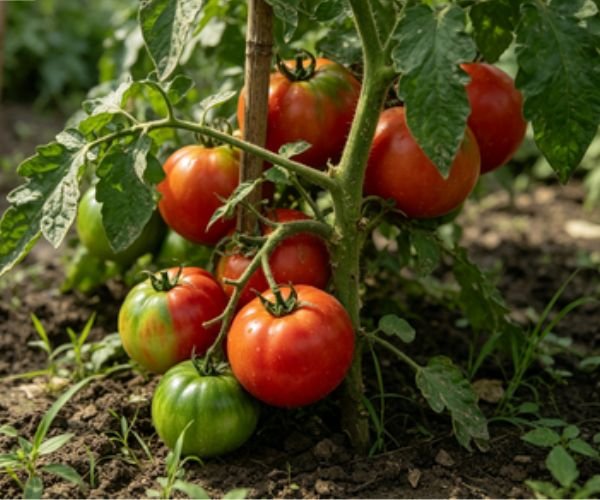
Poor tomato coloration, uneven ripening, green shoulders, and low taste quality are common challenges that directly affect growers’ profitability.
Producing premium-quality tomatoes requires more than simply increasing fertilizer input. Fruit color development is a complex physiological process influenced by temperature, light, plant nutrition, root activity, and hormonal regulation.
Understanding the coloring mechanism and applying targeted nutrition management during the critical growth stages can significantly improve tomato quality and market value.
1. The Physiological Mechanism of Tomato Fruit Coloring
Tomato is a typical climacteric fruit. During the maturation process, the fruit generally develops through three main stages:
Green mature stage → Color turning stage → Full ripening stage
Green mature stage
During this stage, the fruit mainly focuses on cell expansion, dry matter accumulation, and nutrient storage.
Color turning stage
This is the most critical period for tomato quality formation.
The fruit color gradually changes from green to yellow, orange, and finally red. During this stage, major physiological changes occur:
- Chlorophyll degradation accelerates;
- Carotenoid accumulation increases;
- Sugar content rises;
- Organic acids decrease;
- Ethylene production increases and triggers fruit ripening.
Full ripening stage
During final maturation, lycopene accumulates rapidly, creating the characteristic red color of tomatoes.
2. Key Factors Affecting Tomato Color Development
1) Lycopene accumulation and chlorophyll degradation
The red color of tomato fruit mainly comes from lycopene, an important carotenoid.
Higher lycopene accumulation results in:
- Brighter red color;
- Better visual quality;
- Higher commercial value.
High-quality tomatoes usually contain approximately 5–10 mg/100g lycopene after full ripening.
However, excessive temperature and nutritional imbalance can inhibit lycopene synthesis and delay coloration.
2) Sugar accumulation and taste improvement
During the ripening period, starch is gradually converted into:
- Glucose;
- Fructose.
At the same time, organic acids such as citric acid and malic acid gradually decrease, improving the tomato’s sugar-acid balance and taste.
Potassium plays an important role in:
- Sugar transportation;
- Photosynthetic product accumulation;
- Fruit enlargement;
- Quality improvement.
3) Ethylene regulation during ripening
Tomato ripening is regulated by ethylene.
During the color turning stage, the activities of ethylene biosynthesis enzymes:
- ACS (ACC synthase)
- ACO (ACC oxidase)
increase, activating the ripening signal and promoting fruit coloration.
3. Main Causes of Poor Tomato Coloring
Common tomato coloring disorders include:
- Uneven coloration;
- Green shoulders;
- Sunscald;
- Yellow or white patches;
- Delayed ripening.
The main causes include:
High temperature stress
When temperatures exceed 30°C, lycopene synthesis is strongly inhibited.
High temperature conditions may result in:
- Slow red color development;
- Green shoulders;
- Uneven ripening.
Strong sunlight combined with high fruit surface temperature may also cause sunscald, showing white or orange-red damaged areas.
Potassium deficiency and nutrient imbalance
Potassium is essential for tomato fruit quality.
Insufficient potassium supply affects:
- Carbohydrate transportation;
- Lycopene formation;
- Fruit color intensity.
During the fruiting stage, tomato plants have significantly increased potassium demand.
However, excessive calcium application may interfere with potassium uptake, causing hidden potassium deficiency and poor coloration.
A suitable potassium-calcium balance should be maintained:
- Susceptible varieties: K:Ca around 2:1;
- Medium tolerance varieties: K:Ca around 3:1;
- Highly tolerant varieties: K:Ca around 4:1.
Excess nitrogen during fruit maturation
Excessive nitrogen application during the fruiting stage can cause:
- Excessive vegetative growth;
- Delayed maturity;
- Reduced sugar accumulation;
- Uneven fruit coloring.
During the ripening stage, nutrient management should shift from vegetative growth promotion toward fruit quality improvement.
Poor light and water management
Continuous cloudy or rainy weather reduces plant transpiration and weakens potassium transport to fruits.
Sudden sunny weather after prolonged rainfall can cause excessive leaf transpiration and insufficient water supply to fruits, resulting in vascular damage and uneven coloration.
Therefore, maintaining active roots and improving water absorption capacity are essential for stable fruit coloring.
4. Fertilization Strategy During Tomato Fruit Setting and Coloring Stage
During fruit setting, tomato plants require large amounts of nutrients.
The key goal is:
Balanced nutrition management to achieve strong plants, good fruit expansion, and uniform coloration.
1) Choose highly efficient and root-friendly fertilizers
Recommended fertilizer characteristics:
- High nutrient utilization efficiency;
- Balanced nutrient supply;
- Low salt index;
- Root-safe formulation.
Fertilizers containing:
- Seaweed extract;
- Organic nutrients;
- DMPP technology;
can help improve nutrient efficiency, root activity, and plant stress resistance.
2) Adjust fertilizer formulas according to growth stages
Fruit setting stage
The plant requires balanced nutrition to support continuous fruit development.
A balanced NPK fertilizer such as:
20-20-20
can support:
- Healthy plant growth;
- Fruit expansion;
- Continuous flowering and fruit setting.
Color turning stage
The nutritional focus should shift toward potassium supply.
High potassium fertilizer helps:
- Increase sugar transportation;
- Promote lycopene accumulation;
- Improve fruit color.
A practical strategy is alternating:
Balanced fertilizer + high potassium fertilizer
For example:
20-20-20 and 10-10-40 can be applied alternately according to crop conditions.
Avoid excessive high potassium input, which may increase root stress and accelerate plant aging.
3) Supplement calcium, boron, and zinc
During fruit development, tomatoes have high demand for:
- Calcium;
- Boron;
- Zinc.
These nutrients contribute to:
- Fruit firmness;
- Cell wall development;
- Flower and fruit quality;
- Stress resistance.
Chelated micronutrients are recommended because they provide better absorption efficiency.
Foliar application should focus on:
- Young fruits;
- Upper functional leaves.
Application interval is generally around 7 days depending on crop conditions.
5. Recommended Solution for Tomato Coloring Improvement
During the tomato color turning stage, a targeted combination can effectively improve fruit coloration:
Prohydrojasmon (PDJ) + MKP + Sugar Alcohol Boron
Prohydrojasmon (PDJ)
Helps regulate fruit ripening-related metabolism and promotes lycopene accumulation.
Monopotassium Phosphate (MKP)
Provides rapidly available phosphorus and potassium to support:
- Sugar transportation;
- Fruit coloring;
- Quality improvement.
Sugar Alcohol Boron
Improves nutrient mobility and supports uniform fruit development.
This combination is especially suitable for solving:
- Slow coloring;
- Uneven ripening;
- Poor fruit appearance.
6. Root Health Management: The Foundation of Better Coloring
Healthy roots are the foundation of nutrient absorption and fruit quality.
Continuous tomato cultivation often leads to:
- Soil compaction;
- Salinity accumulation;
- Reduced root activity;
- Replanting problems.
Even when nutrients exist in the soil, weak roots cannot effectively transport them to fruits.
Using beneficial microorganisms and organic nutrition can help:
- Improve soil structure;
- Activate soil nutrients;
- Promote phosphorus and potassium availability;
- Enhance root growth.
Conclusion: Better Tomato Coloring Starts with Scientific Nutrition Management
Tomato coloration is not controlled by potassium alone.
It is the result of the interaction between:
Root health + Balanced nutrition + Temperature management + Light conditions + Plant growth regulation
By maintaining strong roots, balancing potassium and calcium nutrition, controlling nitrogen input, and applying targeted coloring solutions during the ripening stage, growers can achieve:
✓ Brighter red color
✓ Higher sugar content
✓ More uniform maturity
✓ Better market value
Grow Better Tomatoes with Wellyou Tech
At Wellyou Tech, we focus on providing professional plant nutrition solutions, including biostimulants, specialty fertilizers, micronutrients, and customized crop management programs.
With strong technical support and practical agricultural experience, Wellyou Tech helps growers and distributors improve crop quality, optimize nutrition efficiency, and achieve more sustainable agricultural production.
Contact Wellyou Tech today to explore customized tomato nutrition solutions for your market.