
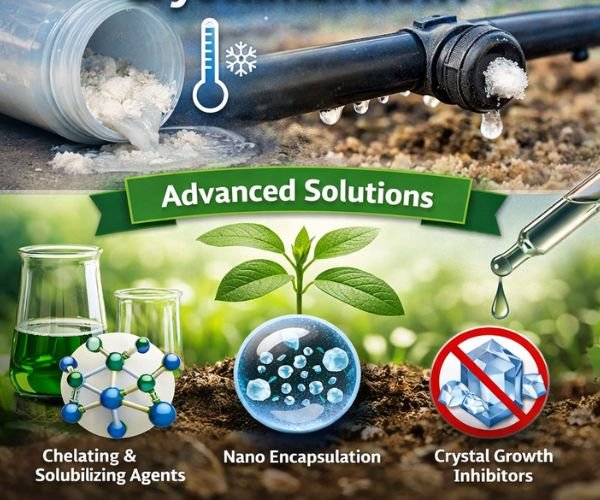
As liquid fertilizers become a central component of modern fertigation systems, maintaining product stability has become a critical challenge for manufacturers and distributors worldwide.
In cold storage conditions or during seasonal temperature fluctuations, liquid fertilizers may occasionally develop crystals or sediment, which can affect nutrient uniformity and in some cases interfere with irrigation systems.
While often misunderstood as simply a “temperature problem,” crystallization is actually the result of complex physicochemical interactions within the fertilizer solution. Understanding these mechanisms allows manufacturers to design formulations that remain stable under real-world agricultural conditions.
With the rapid expansion of precision irrigation and water-soluble fertilizer technologies, solving the crystallization challenge is essential to delivering reliable products to global growers.
Understanding Why Liquid Fertilizers Crystallize
Crystallization occurs when the solubility equilibrium within a fertilizer solution is disrupted. Three key mechanisms typically contribute to this process.
Temperature-Dependent Nutrient Solubility
Most fertilizer salts exhibit strong temperature-dependent solubility. Nutrients that dissolve easily at higher temperatures may become unstable when temperatures drop.
For example, potassium salts commonly used in high-potassium formulations show significant reductions in solubility under cold conditions. When nutrient concentrations approach saturation levels, even small temperature decreases can trigger crystal formation.
This is why high-concentration liquid fertilizers require careful formulation design, particularly for distribution in regions with cold winters.
Ionic Interactions and Precipitation Reactions
Liquid fertilizers contain multiple dissolved ions that can interact with each other.
Certain combinations may lead to the formation of insoluble compounds, particularly when pH levels fluctuate. For example:
- Calcium and magnesium reacting with phosphate or sulfate ions
- Reduced stability of chelated micronutrients
- pH shifts altering nutrient availability
When these reactions occur, nutrients that were previously dissolved can gradually precipitate, forming crystals or sediment.
Maintaining balanced ionic composition and stable chelation systems is therefore essential for long-term product stability.
Colloidal Instability in Biostimulant-Based Fertilizers
Many modern liquid fertilizers incorporate biostimulant ingredients such as humic acids, amino acids, or seaweed extracts.
These products often rely on stable colloidal systems. Environmental stress factors—including temperature changes, high salt concentration, or pH shifts—can destabilize these systems and lead to flocculation or sediment formation.
In such cases, crystallization may occur together with colloidal aggregation.
Advanced Strategies for Preventing Crystallization
Modern fertilizer technology addresses crystallization through integrated formulation and process design, rather than relying on a single additive.
Multi-Functional Stabilizing Additives
Recent industry developments have introduced composite stabilizing systems that combine several functions:
Freezing Point Regulators
Bio-based polyols and advanced dispersants can lower the freezing point of fertilizer solutions and delay crystal formation under cold conditions.
Solubility and Chelation Enhancers
New-generation chelating agents and solubilizing molecules improve nutrient stability and prevent micronutrient precipitation.
Biodegradable chelating agents such as Polyaspartic Acid (PASP) and GLDA (Tetrasodium Glutamate Diacetate) are increasingly used due to their strong stability and environmental compatibility.
Crystal Growth Inhibitors
Certain functional polymers can attach to crystal surfaces and prevent further crystal growth. Even if crystallization begins, particles remain extremely small and dispersed, minimizing the risk of sediment accumulation or irrigation blockage.
Together, these technologies significantly enhance the low-temperature stability of modern liquid fertilizers.
Manufacturing Process Optimization
Beyond formulation, production processes play an equally important role in preventing crystallization.
Controlled Dissolution Sequence
Raw materials should be dissolved sequentially to prevent localized supersaturation during mixing. Chelating agents and micronutrients are typically dissolved first, followed by macronutrient sources.
Homogenization and Particle Stabilization
Advanced homogenization processes help ensure a uniform and stable solution, particularly for high-concentration products.
pH Buffering Systems
Maintaining a stable pH range between 5.5 and 6.5 helps prevent unwanted precipitation reactions while maintaining chelation stability.
These process improvements can dramatically improve product stability during transportation and storage.
Storage and Handling Best Practices
Even well-formulated products require appropriate storage and handling.
Recommended practices include:
- Store liquid fertilizers in moderate temperature environments whenever possible
- Avoid prolonged exposure to freezing conditions
- Keep containers sealed to prevent concentration changes due to evaporation
- Use filtration systems when applying fertilizers through drip irrigation
If crystals appear due to low temperatures, most products can recover after gradual warming and gentle mixing, allowing the nutrients to fully dissolve again.
Future Innovations in Liquid Fertilizer Stability
Research and development in fertilizer science continues to advance rapidly. Several emerging technologies are expected to further improve product stability in the coming years.
These include:
- Biotechnology-derived stabilizing additives that are fully biodegradable
- Nano-encapsulation technologies that protect nutrients from ionic reactions
- AI-assisted formulation platforms capable of predicting crystallization risk based on climate conditions
- Smart temperature-responsive additives that adapt to environmental changes
Such innovations will enable the next generation of liquid fertilizers to maintain stability across diverse agricultural climates worldwide.
Supporting Stable Fertigation Solutions
Preventing crystallization requires a holistic approach, combining formulation science, manufacturing expertise, and proper storage practices.
At Wellyou Tech, we continuously follow global research developments and integrate advanced stabilization technologies into our fertilizer solutions. Our goal is to ensure that liquid fertilizers remain stable, efficient, and compatible with modern irrigation systems, supporting growers in achieving consistent crop performance.
As precision agriculture continues to expand worldwide, reliable liquid fertilizer technologies will play an increasingly important role in delivering efficient nutrient management and sustainable agricultural productivity.