
Understanding soil silicon forms, availability, cycling, and its role in sustainable crop nutrition
Silicon is one of the most abundant elements in the Earth’s crust. It accounts for approximately 27.7% of the Earth’s crust by weight, making it the second most abundant element after oxygen.
However, there is an interesting contradiction: although soils contain enormous amounts of silicon, plants cannot necessarily access enough of it.
Why does this happen? Where is silicon stored in soil? What determines its availability to plants? And how can farmers improve soil silicon nutrition?
Understanding the answers requires looking beyond total silicon content and exploring the dynamic relationship between soil minerals, microorganisms, and plant roots.
1. Silicon in Soil: Abundant but Not Always Available
Silicon exists naturally in almost all soils, but its availability depends largely on its chemical form.
Most soil silicon is locked in relatively stable minerals, such as quartz, feldspar, and clay minerals. These forms represent a large silicon reserve, but they release silicon very slowly under normal agricultural conditions.
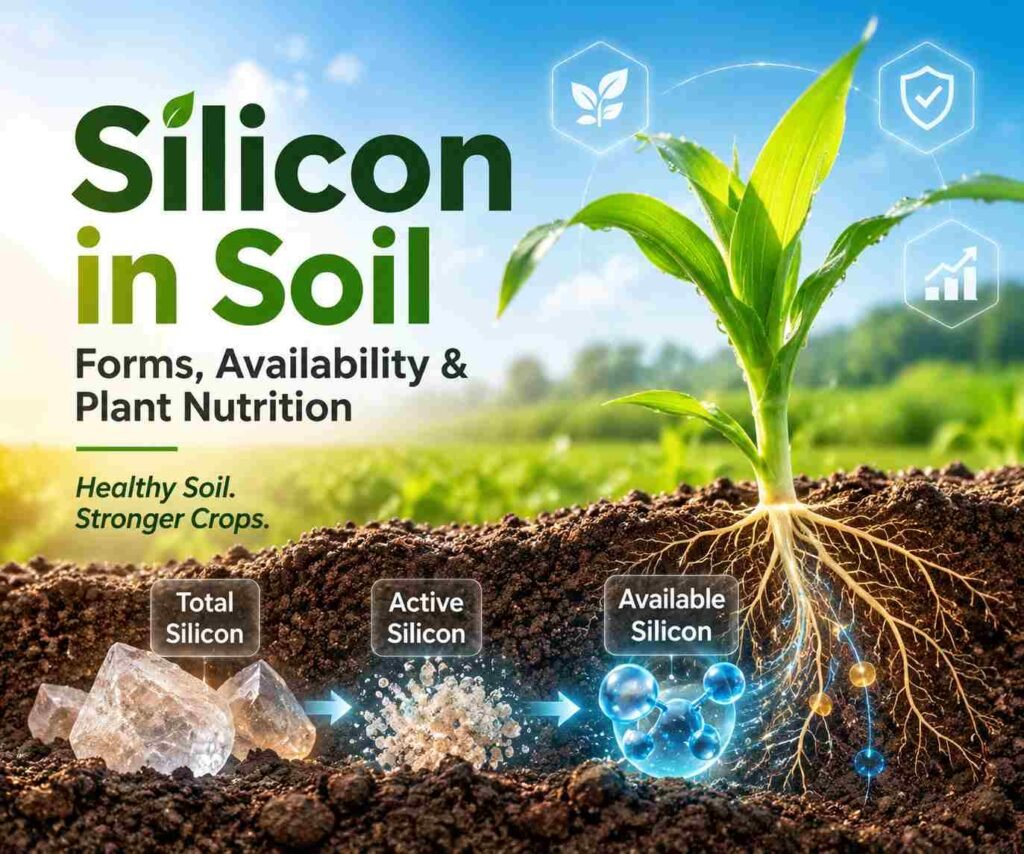
From a plant nutrition perspective, soil silicon can be broadly divided into three pools:
1. Total Silicon – The Long-Term Reserve
Total silicon is mainly present in primary minerals, including quartz and feldspar, as well as secondary silicate clay minerals.
Although this pool contains most of the silicon in soil, its stable crystalline structure makes it difficult for plants to use directly.
It serves as a long-term reservoir that gradually releases silicon through weathering and biological processes.
2. Active Silicon – The Potential Supply
Active silicon includes amorphous silica, adsorbed silicon, and certain secondary silicon compounds.
Compared with crystalline minerals, these forms are generally more reactive and can release soluble silicon under suitable soil conditions.
This pool acts as a bridge between the large mineral silicon reserve and the small amount of silicon immediately available to plants.
3. Available Silicon – The Form Plants Can Absorb
The primary plant-available form of silicon in soil solution is monosilicic acid, also known as orthosilicic acid (H₄SiO₄).
Plants absorb this soluble form through their roots using specific silicon transport mechanisms.
Therefore, the total silicon content of a soil does not necessarily reflect its actual ability to supply silicon to crops.
The key principle: Soil silicon availability depends not only on how much silicon is present, but also on how efficiently it can be released into soil solution.
2. How Does Silicon Transform in Soil?
Soil silicon is not static. It continuously moves between mineral, soluble, and biological pools through physical, chemical, and biological processes.
The transformation generally follows three major stages:
Stage 1: Mineral Weathering
Physical and chemical weathering gradually break down silicon-containing minerals.
Temperature changes, water, carbon dioxide, and organic acids contribute to mineral decomposition and silicon release.
This is the natural starting point of the soil silicon cycle.
Stage 2: Silicon Activation
Amorphous silicon and other reactive forms can dissolve and release monosilicic acid into soil solution.
Plant roots and soil microorganisms contribute to this process.
Root exudates, including organic acids, can modify the rhizosphere environment and promote the dissolution of certain mineral-bound forms of silicon.
Some microorganisms can also produce organic acids and other metabolites that facilitate mineral weathering.
Stage 3: Plant Uptake and Soil Redistribution
Once available in soil solution, monosilicic acid can follow three main pathways:
- Plant uptake: Roots absorb soluble silicon, which is transported to stems, leaves, and other plant tissues.
- Soil fixation: Some silicon is adsorbed by soil colloids or interacts with iron and aluminum oxides.
- Leaching: Soluble silicon can move downward with irrigation water or rainfall, potentially leaving the root zone.
These processes determine how efficiently soil silicon is supplied to growing crops.
3. What Factors Affect Silicon Availability in Soil?
The concentration of plant-available silicon is influenced by soil properties, climate, and biological activity.
Soil pH
Soil pH plays an important role in regulating silicon solubility and adsorption.
- Strongly acidic soils: Iron and aluminum oxides can strongly adsorb silicon, reducing its availability to plants.
- Moderately acidic to neutral soils: Under many soil conditions, silicon availability can be relatively favorable.
- Strongly alkaline soils: Silicon may undergo polymerization or precipitation reactions, depending on soil chemistry, reducing its soluble fraction.
The pH range of approximately 6.0–7.0 is identified in the presentation as a favorable range for soil silicon availability. However, actual conditions vary with soil mineralogy and other chemical properties.
Soil Texture
Soil texture affects both silicon retention and movement.
Clay soils: Clay particles can retain silicon through adsorption, but they may also fix it in less available forms.
Sandy soils: Their relatively low water and nutrient retention capacity increases the potential for soluble silicon to be lost through leaching.
Consequently, sandy soils may require more careful silicon management.
Soil Organic Matter
Organic matter contributes to silicon cycling in two important ways.
First, organic matter decomposition produces organic acids, such as citric acid and oxalic acid. These compounds can interact with iron and aluminum, potentially reducing silicon fixation and promoting its release.
Second, organic matter provides carbon and energy for soil microorganisms, supporting biological processes involved in mineral weathering and silicon activation.
Maintaining soil organic matter is therefore an important component of sustainable soil silicon management.
Climate Conditions
Temperature and rainfall influence silicon availability through different mechanisms.
Higher temperatures can accelerate chemical weathering and promote silicon release from minerals.
Rainfall has a dual effect: it supports mineral weathering but can also increase silicon leaching, particularly in sandy soils.
This explains why warm, humid regions may experience substantial silicon release but still have low plant-available silicon due to intensive leaching.
Plant Roots and Soil Microorganisms
The rhizosphere is one of the most active areas of soil silicon transformation.
Root exudates can modify local pH and release organic acids, helping mobilize certain forms of mineral-bound silicon.
Silicate-solubilizing microorganisms can contribute to mineral decomposition and silicon release through their metabolic activities.
Together, plant roots and microorganisms help regulate the transformation of soil silicon into plant-available forms.
4. How Does Silicon Benefit Plant Growth?
Silicon is generally considered a beneficial element rather than an essential nutrient for all higher plants. However, it plays important roles in many crops, particularly silicon-accumulating species such as rice and sugarcane.
After absorption, silicon is transported through the plant and deposited in different tissues, especially leaves and stems.
It can form hydrated amorphous silica structures known as phytoliths.
These deposits contribute to several important plant functions:
Improved Structural Strength
Silicon deposition in plant tissues can strengthen cell walls and improve mechanical resistance, helping reduce lodging in susceptible crops.
Better Tolerance to Environmental Stress
Silicon nutrition can contribute to plant tolerance against certain abiotic stresses, including drought, salinity, and temperature stress.
Support for Plant Defense
Silicon deposition and silicon-related physiological responses can strengthen plant defense against certain pests and diseases.
Improved Crop Performance
By supporting plant structure and stress responses, adequate silicon nutrition can contribute to more stable crop growth and productivity under challenging growing conditions.
The actual response depends on crop species, soil conditions, silicon source, and application strategy.
5. How Can Farmers Identify Silicon Deficiency in Soil?
Total silicon analysis alone is not sufficient to evaluate soil silicon nutrition.
The more important indicator is plant-available silicon, assessed using an appropriate soil extraction and laboratory testing method.
The presentation provides the following indicative classification:
| Soil available silicon | Classification | General interpretation |
|---|---|---|
| Below 30 mg/kg | Very low | Severe silicon deficiency |
| 30–50 mg/kg | Low | Insufficient silicon supply |
| 50–100 mg/kg | Medium | Generally adequate supply |
| Above 100 mg/kg | High | Relatively sufficient supply |
According to this classification, soil available silicon below 50 mg/kg indicates that additional silicon management should be considered, especially for silicon-demanding crops.
Important: These values should be treated as reference thresholds, not universal standards. Soil extraction methods, soil types, crop requirements, and local agricultural recommendations can produce different interpretations.
Farmers should follow locally validated soil testing methods when making fertilizer decisions.
6. How Can We Improve Soil Silicon Availability?
Maintaining soil silicon balance requires more than simply adding fertilizer. A combination of soil management, external silicon inputs, and biological activation can provide a more sustainable approach.
1. Return Crop Residues to the Soil
Crop residues, particularly rice straw, are important sources of recycled silicon.
Rice straw can contain approximately 10–15% silicon on a dry-weight basis, according to the presentation.
When residues are returned to farmland, decomposition gradually releases silicon back into the soil.
Straw incorporation also contributes organic matter and supports soil biological activity.
For intensive cropping systems, residue management is an important practice for maintaining long-term soil silicon reserves.
2. Apply Silicon Fertilizers
When soil testing indicates insufficient available silicon, silicon fertilizers can provide an additional source.
Common categories include:
- Calcium silicate and other citrate-soluble silicon materials.
- Sodium silicate and other water-soluble silicon sources.
- Other locally registered silicon-containing soil amendments.
Different silicon sources have different solubility, release rates, and application characteristics.
The selection should consider soil pH, crop requirements, fertilizer compatibility, application method, and local regulations.
3. Use Silicate-Solubilizing Microbial Products
Another approach is to improve the utilization of existing soil silicon reserves.
Silicate-solubilizing microorganisms can help mobilize certain mineral-bound forms of silicon through their metabolic activities.
This approach focuses on activating native soil resources rather than relying entirely on external silicon inputs.
When combined appropriately with organic matter management and silicon fertilizer application, biological activation may contribute to a more sustainable soil nutrition strategy.
7. Why Is Soil Silicon Balance Important for Sustainable Agriculture?
Every growing season, crops absorb nutrients from the soil. When harvested, part of the absorbed silicon is removed from the agricultural system.
If crop residues are also removed and no additional silicon is supplied, soil silicon reserves may gradually decline.
The presentation illustrates three different management scenarios:
- Severe depletion: Crop residues are removed and no silicon fertilizer is applied.
- Near balance: Crop residues are returned to the soil, partially compensating for silicon removal.
- Positive balance: Crop residues are returned and additional silicon fertilizer is applied.
The key message is straightforward: sustainable silicon management requires balancing silicon inputs and outputs.
An integrated strategy combining residue recycling, soil testing, appropriate silicon fertilizers, and biological activation can help maintain soil silicon supply over the long term.
Conclusion: Look Beyond Total Silicon Content
Silicon is abundant in soil, but abundance does not always mean availability.
Most soil silicon is stored in stable mineral forms. Only a small fraction is immediately available to plants as soluble monosilicic acid.
Understanding the relationship between total silicon, active silicon, and available silicon is essential for effective soil nutrient management.
For farmers and agricultural professionals, the priority should be to:
- Monitor plant-available silicon rather than relying only on total silicon content.
- Maintain soil organic matter and support beneficial microbial activity.
- Return crop residues whenever agronomically appropriate.
- Select suitable silicon fertilizers based on soil and crop requirements.
- Develop integrated silicon management strategies for long-term soil productivity.
Healthy soil is not simply soil rich in nutrients. It is soil capable of supplying nutrients in the right forms, at the right time, and in the right amounts.
At Wellyou Tech, we believe that understanding soil nutrient dynamics is the foundation of better agricultural solutions.