
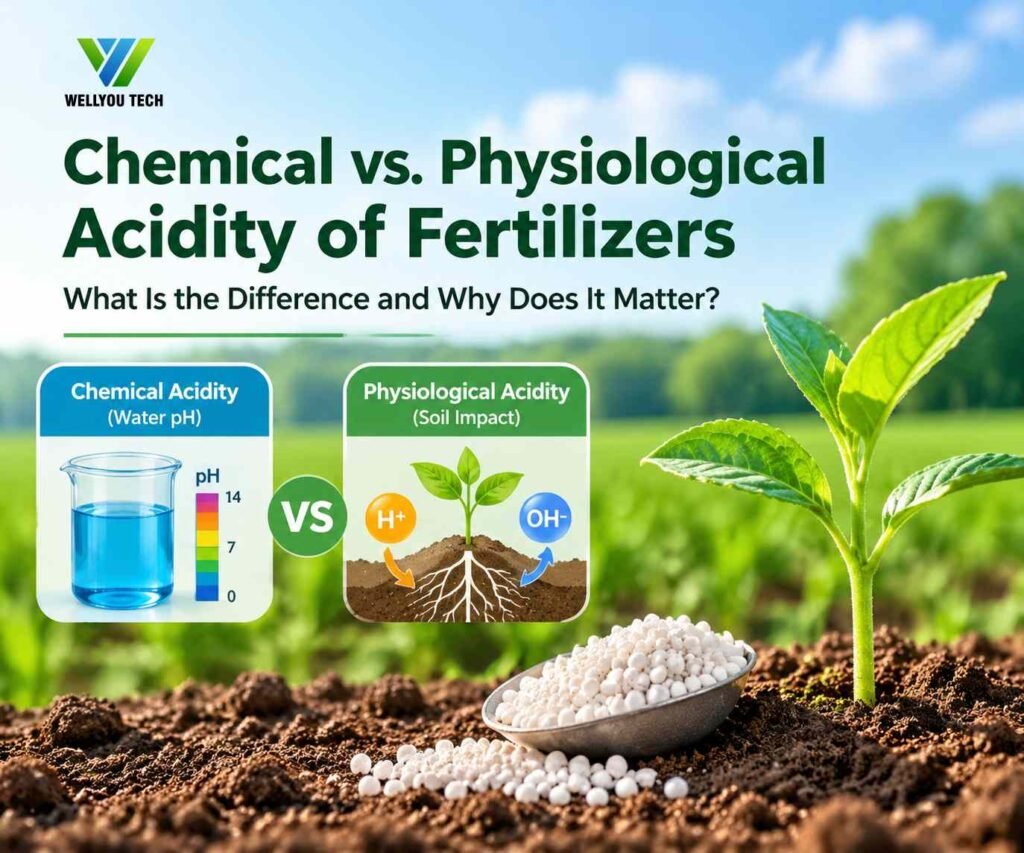
Understanding how fertilizers affect soil pH is essential for effective nutrient management, healthy root development, and long-term soil fertility.
When choosing fertilizers, growers often focus on NPK ratios, nutrient content, solubility, and price. However, one important factor is sometimes overlooked: the effect of fertilizers on soil acidity and alkalinity.
A fertilizer may produce an acidic solution when dissolved in water but have a different effect on soil after application. Likewise, a chemically neutral fertilizer does not necessarily mean it will have no impact on soil pH over time.
This is because fertilizer acidity involves two different concepts: chemical acidity and physiological acidity.
Let’s explore how they differ, which common fertilizers belong to each category, and what growers should consider when selecting fertilizer formulations.
1. Chemical Acidity: What Is the pH of a Fertilizer Solution?
Chemical acidity refers to the acidity or alkalinity of a fertilizer solution after the fertilizer dissolves in water.
It is determined by measuring the pH of the solution under specified testing conditions.
- Acidic: pH below 7
- Neutral: pH around 7
- Alkaline: pH above 7
The actual pH depends on the fertilizer’s chemical composition, concentration, water quality, temperature, and other testing conditions.
Examples of common fertilizers
| Fertilizer | Typical chemical behavior |
|---|---|
| Potassium sulfate (K₂SO₄) | Generally close to neutral |
| Single superphosphate (SSP) | Generally acidic |
| Ammonium bicarbonate (NH₄HCO₃) | Alkaline |
| Potassium chloride (KCl) | Generally close to neutral |
| Potassium nitrate (KNO₃) | Generally close to neutral |
Important: These are general descriptions, not guaranteed pH specifications. Actual measurements should be made using a defined fertilizer-to-water ratio and an appropriate testing method.
Chemical acidity tells us what happens when a fertilizer dissolves in water. It does not, by itself, tell us how the fertilizer will affect soil pH after application.
2. Physiological Acidity: How Does Fertilizer Affect Soil pH?
Physiological acidity describes how a fertilizer influences the soil or root-zone pH through plant nutrient uptake and subsequent biological and chemical processes.
Unlike chemical acidity, it is not determined simply by measuring the fertilizer solution.
One important mechanism is the difference in how plants absorb positively charged ions (cations) and negatively charged ions (anions).
For example:
- When plants absorb more cations, they generally release H⁺ ions from their roots to maintain electrical balance, which can lower the pH around the roots.
- When plants absorb more anions, they may release OH⁻ or HCO₃⁻, which can increase the pH around the roots.
The final effect also depends on nitrogen transformations, microbial activity, nutrient leaching, soil buffering capacity, and crop characteristics.
Based on their general effects, fertilizers can be discussed in three groups.
A. Physiologically Acid-Forming Fertilizers
These fertilizers tend to contribute to soil or rhizosphere acidification.
Common examples include:
- Ammonium sulfate ((NH₄)₂SO₄)
- Ammonium chloride (NH₄Cl)
- Potassium chloride (KCl)
- Potassium sulfate (K₂SO₄)
- Monoammonium phosphate (MAP), depending on soil and application conditions
There are two important mechanisms:
1. Selective nutrient uptake
Plants often absorb more potassium than chloride or sulfate relative to their nutritional requirements. This can result in a net acidifying effect around the roots.
2. Ammonium nitrification
Ammonium-based nitrogen fertilizers can acidify soil when soil microorganisms convert ammonium (NH₄⁺) into nitrate (NO₃⁻).
This process releases hydrogen ions (H⁺), contributing to soil acidification.
For this reason, the long-term and excessive use of ammonium-based fertilizers deserves particular attention, especially in already acidic soils.
B. Physiologically Alkaline-Forming Fertilizers
These fertilizers tend to increase the pH around the root zone or have a net alkalizing effect under suitable conditions.
Common examples include:
- Sodium nitrate (NaNO₃)
- Calcium nitrate (Ca(NO₃)₂)
- Potassium nitrate (KNO₃)
- Some phosphate and calcium-based fertilizers, depending on their composition and soil reactions
The main mechanism is often nitrate uptake.
When plants absorb nitrate (NO₃⁻) in greater quantities relative to cation uptake, they may release OH⁻ or HCO₃⁻ to maintain electrical balance.
This can increase the pH in the rhizosphere.
Calcium nitrate and potassium nitrate are therefore useful nitrogen sources to consider when managing nutrient programs in soils with an acidification risk.
However, their actual effects depend on the soil, crop, and overall nutrient management strategy.
C. Fertilizers with Variable or Relatively Small Net Effects
Some fertilizers cannot be reliably classified as physiologically neutral under all conditions.
Their effects depend on the nutrient forms supplied, crop uptake patterns, and soil reactions.
Examples include:
- Urea
- Diammonium phosphate (DAP)
- Ammonium bicarbonate
For instance, urea does not contain ammonium as its original nitrogen form. However, after application, it is hydrolyzed to ammonium and subsequently may undergo nitrification.
Therefore, urea can contribute to soil acidification over time, particularly when nitrate is lost through leaching.
DAP also contains ammonium nitrogen and can contribute to long-term acidification through nitrification, even though its initial reaction in soil may be different.
The key point: A fertilizer should not be classified as physiologically neutral simply because its initial chemical reaction appears neutral or alkaline.
3. Comparison of Chemical and Physiological Acidity in Common Fertilizers
The following table summarizes the two concepts. Physiological effects are general tendencies rather than fixed classifications.
| Fertilizer | Chemical reaction in water | General soil pH effect |
|---|---|---|
| Potassium sulfate | Near neutral | Acid-forming tendency |
| Potassium chloride | Near neutral | Acid-forming tendency |
| Ammonium sulfate | Acidic | Strong acid-forming tendency |
| Ammonium chloride | Acidic | Acid-forming tendency |
| Potassium nitrate | Near neutral | Alkaline-forming tendency |
| Calcium nitrate | Near neutral | Alkaline-forming tendency |
| Urea | Near neutral | Potentially acidifying over time |
| MAP | Acidic | Acidifying potential |
| DAP | Alkaline to near neutral, depending on concentration | Acidifying potential over time |
| Sodium nitrate | Near neutral | Alkaline-forming tendency |
This comparison highlights an important principle:
The chemical pH of a fertilizer solution and its long-term influence on soil pH are two different properties.
4. Do NPK Compound Fertilizers Affect Soil pH?
Yes. Compound fertilizers can influence soil pH, but their effects depend on the complete formulation rather than simply their NPK ratio.
For example, two fertilizers with the same NPK analysis of 15-15-15 may have different effects on soil pH because they can contain different nitrogen sources.
Consider these factors:
Nitrogen form
- Ammonium nitrogen generally has acidifying potential because of nitrification.
- Nitrate nitrogen generally has an alkalizing effect in the rhizosphere when preferentially absorbed.
- Urea can contribute to acidification through subsequent soil transformations.
Potassium source
- Potassium chloride supplies chloride.
- Potassium sulfate supplies sulfate.
- Potassium nitrate supplies nitrate.
These counterions influence nutrient uptake balance and the overall behavior of the formulation.
Phosphorus source
MAP, DAP, and other phosphate sources have different chemical properties and soil reactions. Their effects should be evaluated according to their composition and application conditions.
Therefore, it is not scientifically accurate to assume that every chloride-based or sulfate-based NPK fertilizer has exactly the same soil acidification potential.
The complete nutrient composition matters.
5. How Can Growers Manage Soil pH Through Fertilizer Selection?
Maintaining a suitable soil pH is not about choosing only acidic or alkaline fertilizers. It is about matching nutrient sources to soil conditions, crop requirements, and long-term fertilization goals.
Here are five practical recommendations.
1. Test Soil pH Regularly
Soil testing is the starting point for effective fertilizer management.
A soil test helps identify whether the soil is acidic, neutral, or alkaline and provides useful information about nutrient availability and potential deficiencies.
Do not rely on fertilizer solution pH as a substitute for soil testing.
2. Choose Nitrogen Sources According to Soil Conditions
In soils with a history of acidification, growers may consider incorporating nitrate-based nitrogen sources into their nutrient management programs.
In other situations, ammonium-based fertilizers may be appropriate and agronomically beneficial.
The objective is to balance nutrient requirements while avoiding unnecessary changes in soil pH.
3. Avoid Excessive Dependence on a Single Fertilizer
Continuous application of the same fertilizer source, particularly at excessive rates, may contribute to nutrient imbalances and changes in soil properties.
Combining different nutrient sources according to crop requirements can help improve nutrient management.
However, changing fertilizer types alone does not automatically correct soil acidity.
4. Maintain Soil Organic Matter
Organic matter plays an important role in soil structure, water retention, nutrient cycling, and buffering capacity.
Well-managed organic amendments can support a healthier soil environment and improve the efficiency of fertilizer use.
Their effects on soil pH vary with the material and its decomposition process.
5. Correct Soil Acidity or Alkalinity When Necessary
If soil testing identifies excessive acidity, agricultural lime or dolomitic lime may be recommended, depending on the soil’s calcium and magnesium status.
For alkaline soils, management should focus on the underlying causes, such as carbonate content, irrigation water quality, and nutrient availability.
Simply switching to an acidic fertilizer is not always an effective solution.
6. Why Does Soil pH Matter for Fertilizer Efficiency?
Soil pH influences the availability of many essential nutrients and the activity of soil microorganisms.
When soil pH moves too far from the suitable range for a particular crop, nutrient uptake can become less efficient.
For example:
- In strongly acidic soils, phosphorus availability may decrease, while aluminum and manganese toxicity can become a concern.
- In alkaline soils, iron, zinc, manganese, and phosphorus availability may become limited.
- Unfavorable pH conditions can also affect beneficial microbial activity and root development.
This means that fertilizer selection should not focus only on the amount of nutrients supplied.
The goal is to ensure that nutrients remain available and accessible to crops throughout their growth cycle.
Conclusion: Choose Fertilizers Based on Both Nutrient Content and Soil Conditions
Understanding the difference between chemical acidity and physiological acidity helps growers make better fertilizer decisions.
Chemical acidity describes the pH of a fertilizer solution, while physiological acidity describes how fertilizer nutrients and their subsequent transformations influence the soil and root-zone environment.
Neither property should be considered in isolation.
For sustainable crop nutrition, growers should consider soil pH, nitrogen forms, nutrient balance, crop requirements, and long-term soil management together.
At Wellyou Tech, we believe effective crop nutrition starts with understanding the relationship between fertilizer formulations, soil conditions, and plant requirements.
By selecting suitable nutrient sources and developing balanced fertilization programs, growers can improve nutrient-use efficiency and support healthier crop development.
Frequently Asked Questions (FAQs)
1. Is a fertilizer with a neutral pH always neutral to soil?
No. A fertilizer can have a neutral pH in water but still contribute to soil acidification or alkalization after application. Urea is a good example because its nitrogen undergoes several transformations in soil.
2. Does potassium sulfate make soil acidic?
Potassium sulfate is generally close to neutral when dissolved in water. However, it may have an acidifying effect in the root zone because plants often absorb potassium in greater proportions than sulfate relative to their nutritional requirements.
3. Is calcium nitrate an alkaline fertilizer?
Calcium nitrate is generally close to neutral in water. However, nitrate uptake can have an alkalizing effect in the rhizosphere, making calcium nitrate a useful nitrogen source in certain soil management programs.
4. Does urea increase soil acidity?
Urea can contribute to soil acidification through ammonium formation and subsequent nitrification. The overall effect depends on crop nitrate uptake, nitrogen losses, soil conditions, and fertilizer management.
5. How can farmers prevent soil acidification?
Regular soil testing, balanced nitrogen management, appropriate fertilizer selection, organic matter management, and liming when recommended by soil tests can help prevent excessive soil acidification.
SEO Keywords
fertilizer acidity, chemical acidity of fertilizers, physiological acidity of fertilizers, fertilizer and soil pH, acidic and alkaline fertilizers, soil pH management, ammonium fertilizer, nitrate fertilizer, fertilizer selection, soil fertility management
Suggested Meta Description
Understand the difference between chemical and physiological acidity of fertilizers. Learn how common fertilizers affect soil pH and how to improve nutrient management.
Suggested URL Slug
/insights/chemical-vs-physiological-acidity-of-fertilizers/