
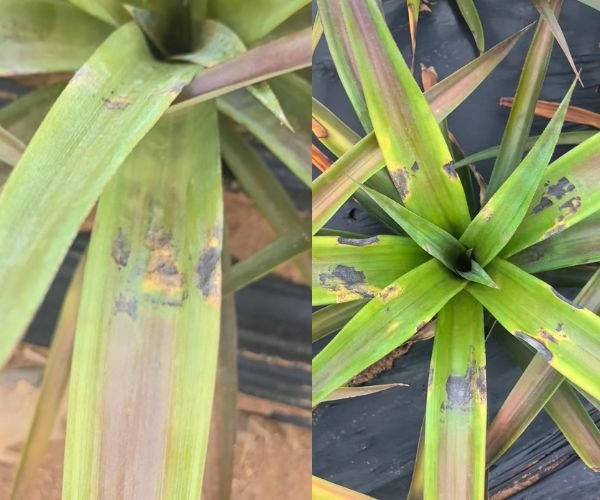
A pineapple grower from Hainan Province, China, applied our Mineral Potassium Fulvate Flakes through root irrigation, with additional foliar application during the crop growth stage.
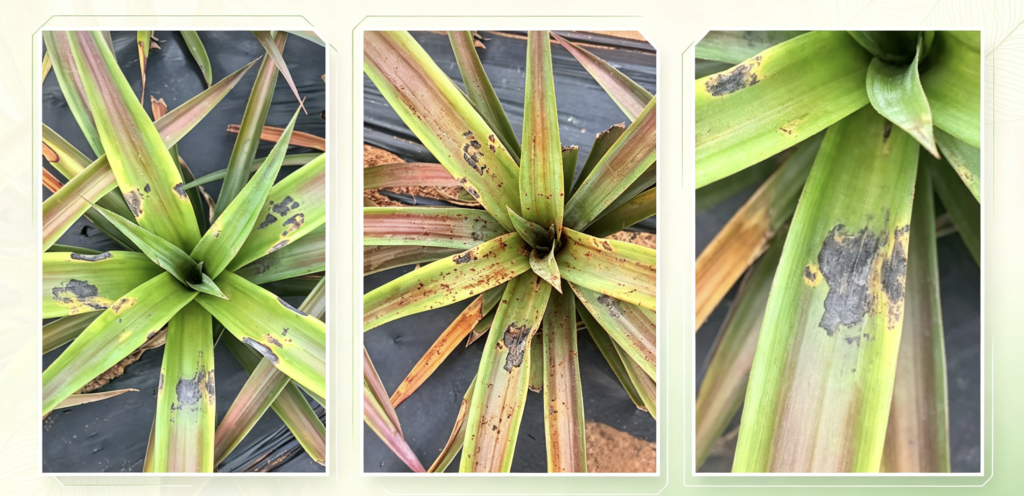
After application, some leaves showed blackened and burned-like symptoms, which attracted the grower’s attention.
Our technical team followed up with the field situation and analyzed the application method, dosage, and symptom distribution.
Field Observation
During the field inspection, we found:
- The affected areas showed a relatively regular distribution pattern, rather than random disease spots.
- The symptoms mainly appeared on plant tissues directly exposed to the application.
- The application concentration was relatively high:
Dosage used:
- Water volume: 5 tons
- Mineral Potassium Fulvate Tablets: 10 kg
This means the concentration reached a high application level, especially when combined with foliar spraying.
Technical Analysis
Based on the field symptoms and application records, the possibility of high concentration stress caused by excessive application rate was considered the main reason.
Mineral Potassium Fulvate is rich in active organic substances and potassium components. When applied at an appropriate concentration, it can help:
✓ Improve nutrient utilization efficiency
✓ Promote root development
✓ Enhance plant stress resistance
✓ Improve crop growth quality
However, as with all highly concentrated agricultural inputs, more is not always better.
When the concentration exceeds the crop’s tolerance range, especially during foliar application, it may cause:
- Leaf surface osmotic stress
- Localized tissue damage
- Leaf tip or edge burning symptoms
Solution & Recommendation
To help the crop recover, we recommended:
1. Reduce application concentration
Adjust the dosage according to:
- Crop growth stage
- Application method
- Environmental conditions
For foliar application, lower concentrations are generally recommended compared with soil application.
2. Apply plant recovery products
The grower was advised to spray Brassinolide (BR) to help:
- Relieve plant stress
- Promote recovery of damaged tissues
- Enhance plant growth regulation
3. Improve future application management
For high-value crops like pineapple, we recommend:
- Small dosage + multiple applications
- Avoid combining high-concentration root irrigation with foliar spraying at the same time
- Conduct a small-area test before large-scale application
Conclusion
This case reminds us that the effectiveness of a biostimulant depends not only on product quality, but also on correct dosage, application method, and crop conditions.
Our technical support team always focuses on helping growers achieve the best results through scientific application management.
The right product + the right dosage + the right timing = better crop performance.