
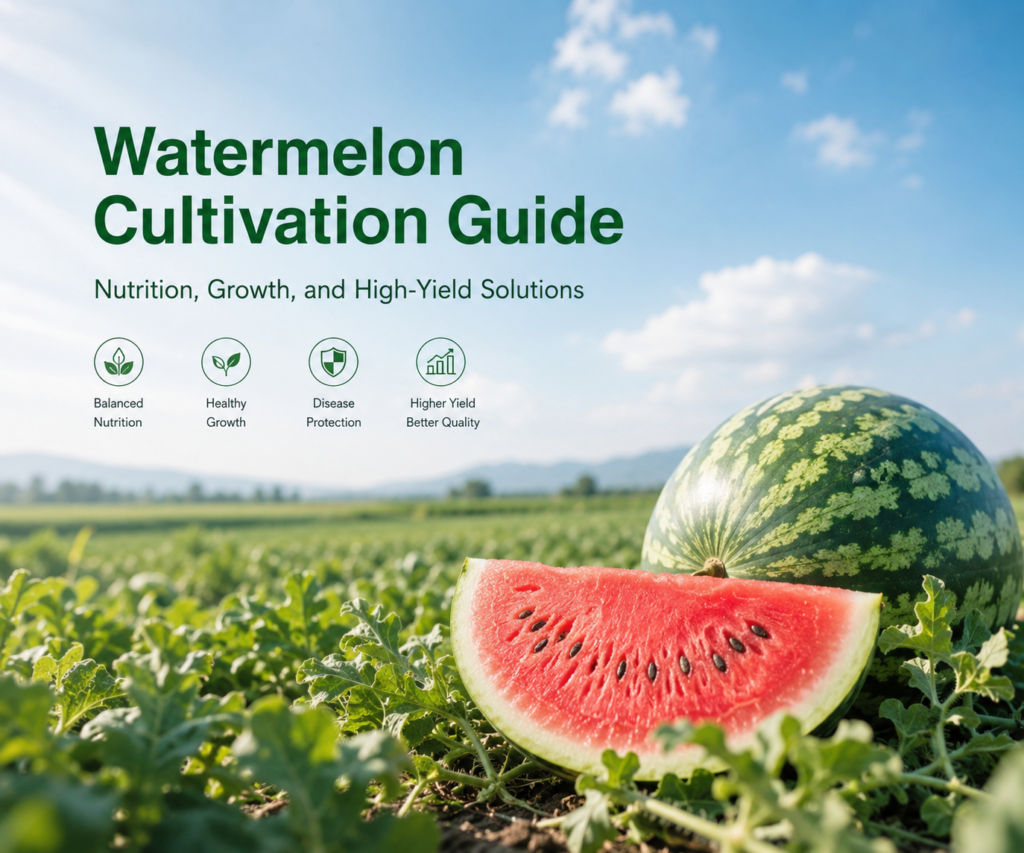
Watermelon (Citrullus lanatus), also known as summer melon or winter melon, is a highly valued vine crop in horticulture. With its sweet, juicy pulp and rich nutrient profile, watermelon holds a prominent place in global fruit production. According to FAOSTAT, watermelon ranks first in global fruit production by volume, highlighting its economic importance.
1. Watermelon Growth Stages and Nutritional Requirements
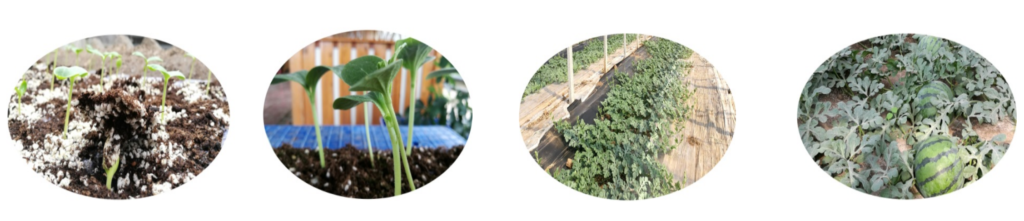
Watermelon development can be divided into several critical stages: seedling, vine elongation, flowering and pollination, and fruit expansion. Each stage has distinct nutrient demands:
- Seedling Stage: Nutrient demand is low (0.54% of total nutrients). Recommended N:P:K ratio is 3.8:1:1.8.
- Vine Elongation Stage: Nutrient demand increases to 14.66% of total; N:P:K ratio 3.6:1:1.7.
- Flowering and Pollination Stage: Nutrient demand is 7.04% of total; focus on N:P:K 3.5:1:4.6 when combined with fruit expansion.
- Fruit Expansion Stage: Critical stage, requiring 77.74% of total nutrients to support fruit growth and quality.
Per 1,000 kg of watermelon production, the approximate nutrient requirements are:
- Nitrogen (N): 2.5–3.0 kg
- Phosphorus (P₂O₅): 0.8–1.0 kg
- Potassium (K₂O): 3.5–4.0 kg
- Calcium (CaO): 4.5–6.0 kg
- Magnesium (MgO): 1.0–1.5 kg
2. Temperature and Environmental Conditions
- Seedling Stage: Substrate temperature ≥10°C (optimal 13°C), daytime 25–28°C; maintain 50–60% humidity.
- Transplanting Stage: Soil temperature ≥13°C (optimal 17°C), root activity peaks at 25–30°C.
- Vine Elongation and Flowering: Temperature control 20–35°C to promote flower differentiation and pollination.
- Fruit Expansion: Optimal 15–30°C; larger day-night temperature variation enhances yield and fruit quality.
3. Foliar Nutrient Management Program
Foliar sprays complement soil fertilization, targeting specific growth stages:
| Stage | Foliar Type | Dosage | Application | Purpose |
|---|---|---|---|---|
| Vine elongation | Low-temperature photosynthesis booster | 120 ml | 1 barrel water/application, 2 times | Mitigate cold stress, enhance photosynthesis |
| Vine elongation | Anti-virus foliar | 120 ml | 2 barrels water/application, 1 time | Increase resistance to viral diseases |
| Flowering | Bio-energy foliar | 120 ml | 2 barrels water/application, 1 time | Supply Zn and B to maintain flowers and fruit set |
| Early fruit expansion | Anti-cracking + Beneficial microbes | 260 ml each | 3 barrels water/application, 2 times | Supply Ca, prevent fruit cracking |
| Fruit expansion | Color-enhancing & sugar-promoting + Mono potassium phosphate | 180 ml each | 3 barrels water/application, 1 time | Enhance sugar accumulation and fruit coloration |
| Second crop | Mono potassium phosphate | 200 g | 3 barrels water/application, 2 times | Delay senescence, improve resistance |
4. Soil Fertilization Strategy
Balanced soil fertilization ensures steady growth and quality fruit production:
| Stage | Fertilizer Type | Application Method | Dosage | Function |
|---|---|---|---|---|
| Basal | 15-15-15 or 17-17-17 | Soil application | 50–100 kg/acre | Adjust pH, improve soil, provide foundational nutrients |
| Basal | Organic carbon fertilizer | Soil application | 40–80 kg/acre | Enhance organic matter |
| Transplant | Beneficial microbes / Potassium humate liquid | Hole application | 50 g/plant | Promote root growth, increase stress resistance, prevent root-knot nematodes |
| Vine elongation | 20-20-20 / 15-5-22 + Potassium humate liquid | Fertigation | 5–10 L/acre | Maintain vigorous but controlled growth |
| Fruit expansion | High-K water-soluble fertilizer 16-8-34 + Potassium humate liquid | Fertigation | 5–10 kg/acre, 2 times | Meet high K demand, enhance sugar content, improve microelement utilization |
5. Case Studies: Nutritional Solutions in Practice
Yinan, Shandong: Acidic soil (pH ≤5) with poor water and nutrient retention. Silicon-calcium-potassium-magnesium fertilizer improved rhizosphere pH, nutrient absorption, and water retention, significantly enhancing fertilizer efficiency.
Qingzhou, Shandong: Heavy, compacted soils with high disease incidence and leaf chlorosis. Nutrient optimization increased element availability, reduced soil-borne disease, and achieved an average yield increase of 7%, with improved taste and quality.
6. Watermelon Disease and Pest Management
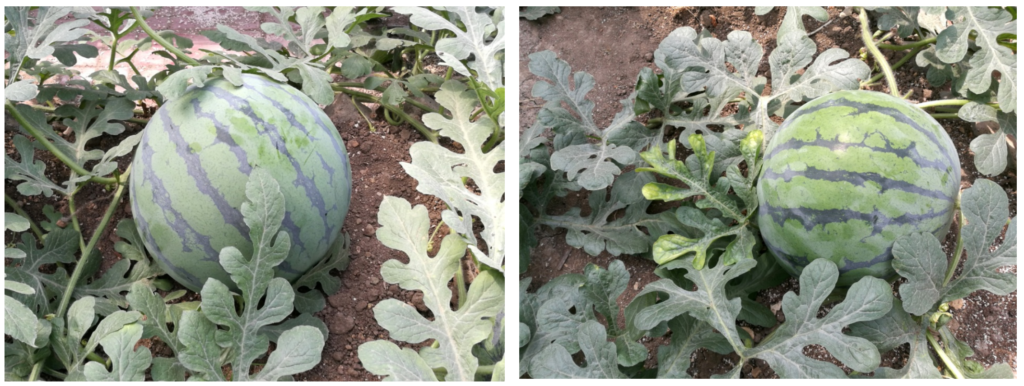
Major Diseases:
- Damping-off, Fusarium wilt, Anthracnose, Downy mildew, Bacterial soft rot, Blossom-end rot, Virus infections.
Pests:
- Aphids, red/ yellow spider mites, melon leaf webworm larvae, thrips.
Control Recommendations:
- Aphids: 25% Imidacloprid 1500–2000× + 50% Pirimicarb 1500–2000×
- Spider mites: 43% Fenpyroximate 100 ml + 0.5% Abamectin 200 ml per 400 jin water
- Thrips: 6% Emamectin 100 ml or 28% Methomyl 200 g per 400 jin water
7. Results and Benefits of Optimized Nutrition
- Improved vine thickness and leaf coloration.
- Enhanced fruit sugar content and taste.
- Reduced fruit cracking by 14.8%, increased single fruit weight by 15%.
- Early harvest by 5 days, net gain per acre approximately CNY 1300–1400.