
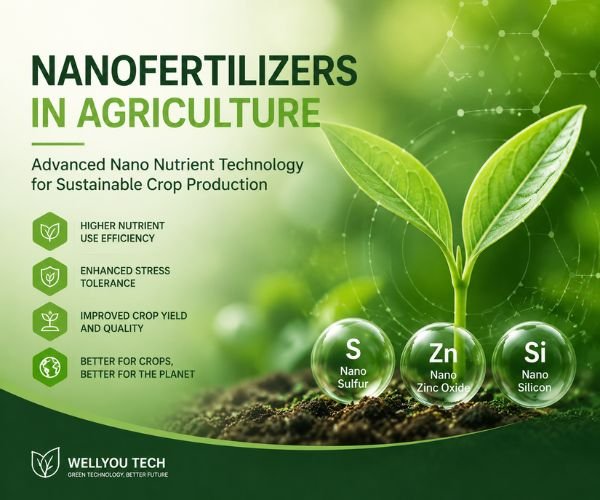
In modern agriculture, improving nutrient efficiency while reducing environmental losses has become a global priority. Conventional fertilizers often suffer from low utilization rates due to leaching, volatilization, and soil fixation. To address these limitations, nanotechnology has introduced a new generation of advanced fertilizers known as nanofertilizers.
Nanofertilizers are nutrient formulations engineered at the nanoscale (typically 1–100 nm), or designed using nano-carriers and dispersion systems to enhance nutrient delivery, stability, and bioavailability. Compared with traditional fertilizers, nanofertilizers offer higher efficiency, controlled release, and improved plant uptake due to their extremely small particle size and large surface area. (MDPI)
What Are Nanofertilizers?
Nanofertilizers are not a single product type, but a broad category of advanced nutrient systems that include:
- Nano-structured nutrient fertilizers
- Nano slow/controlled-release fertilizers
- Nano micronutrient fertilizers
- Nano-functional composite fertilizers
These formulations can deliver macro- and micronutrients such as nitrogen (N), phosphorus (P), potassium (K), zinc (Zn), silicon (Si), sulfur (S), iron (Fe), and others in highly efficient forms.
The key innovation lies in engineering nutrients at the nanoscale or dispersing them into stable colloidal systems, allowing precise nutrient release in the root zone or on leaf surfaces.
How Nanotechnology Improves Fertilizer Performance
Nanofertilizers enhance agricultural efficiency through several mechanisms:
1. High surface area and reactivity
Nano-sized particles provide significantly higher surface interaction with plant tissues, improving absorption efficiency.
2. Controlled nutrient release
Nutrients are gradually released, reducing losses from leaching and volatilization.
3. Improved nutrient use efficiency (NUE)
More nutrients are absorbed by plants instead of being lost in soil systems, improving fertilizer efficiency and reducing application rates.
4. Enhanced stress tolerance
Nanoparticles can stimulate physiological responses in plants, improving resistance to drought, salinity, and disease stress.
Key Types of Functional Nanofertilizers
1. Nano Sulfur (Nano S Fertilizer)
Nano sulfur formulations are based on finely dispersed elemental sulfur stabilized in liquid suspension systems.
Key functions:
- Improves sulfur nutrition (protein & enzyme synthesis)
- Supports oil crop quality and yield
- Contributes to soil pH regulation
- Provides additional protective effects against certain fungal and mite pressures
Nano sulfur is widely used as a dual-function product combining nutrition and plant protection support.
2. Nano Zinc Oxide (Nano ZnO Fertilizer)
Zinc is an essential micronutrient involved in enzyme activation and hormone regulation.
Key functions:
- Enhances auxin (IAA) synthesis for plant growth
- Improves photosynthetic efficiency
- Strengthens root and shoot development
- Increases tolerance to cold and drought stress
Nano ZnO improves zinc availability compared to conventional zinc salts by enhancing mobility and uptake efficiency.
3. Nano Silicon (Nano SiO₂ Fertilizer)
Silicon-based nanofertilizers are increasingly recognized as plant stress defense enhancers.
Key functions:
- Strengthens cell wall structure
- Improves resistance to lodging
- Enhances drought and salinity tolerance
- Reduces disease penetration and stress damage
Nano silicon acts as a biological reinforcement agent, improving overall plant resilience and structural integrity.
Application Methods
Nanofertilizers can be applied through multiple agricultural systems:
- Foliar spraying (leaf absorption)
- Soil application (root uptake)
- Fertigation systems (drip irrigation integration)
Due to their high efficiency, application rates are typically lower than conventional fertilizers, while delivering equal or higher agronomic performance.
Advantages of Nanofertilizer Technology
- Higher nutrient use efficiency
- Reduced fertilizer waste and environmental pollution
- Lower application dosage requirement
- Improved crop yield and quality
- Enhanced plant resistance to abiotic stress
- Compatibility with precision agriculture systems
Future of Nano-Enabled Agriculture
Nanotechnology is driving agriculture toward a more precision-based and resource-efficient system. Future developments are expected to focus on:
- Smart nutrient delivery systems
- Bio-nano hybrid fertilizers
- Controlled-release nano-carriers
- Integration with biostimulants and amino acid technologies
- Data-driven precision fertilization strategies
This evolution will support sustainable agriculture by maximizing productivity while minimizing environmental impact.
Nanofertilizers represent a significant technological advancement in modern agriculture. By integrating nanoscale science with nutrient management, they provide a highly efficient pathway for improving crop productivity, stress tolerance, and soil health.
Products such as nano sulfur, nano zinc oxide, and nano silicon fertilizers demonstrate how nanotechnology can transform traditional fertilization into a more precise, efficient, and sustainable system.
Looking for High-Performance Nanofertilizer Solutions?
Wellyou Tech provides advanced nano sulfur fertilizer, nano zinc oxide fertilizer, and nano silicon fertilizer solutions designed for modern precision agriculture.
We focus on:
- Stable nano suspension technology
- Customized nutrient formulations (OEM/ODM)
- High nutrient use efficiency (NUE) products
- Export-ready quality control systems
Whether you are a distributor, wholesaler, or agricultural input brand, we can support your product development with tailored solutions.