
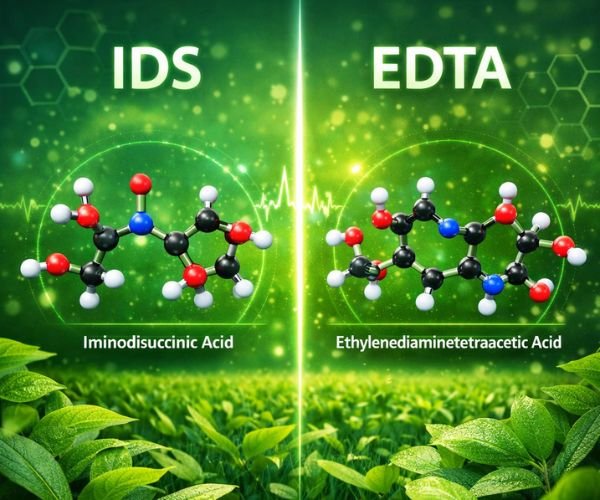
As global agriculture transitions toward higher efficiency and stricter environmental standards, the choice of chelating agents is becoming increasingly critical. Among the most widely discussed options today are EDTA (Ethylenediaminetetraacetic acid) and IDS (Iminodisuccinic Acid).
Both play essential roles in micronutrient delivery—but their long-term agronomic and environmental impacts differ significantly.
This article provides a clear, practical comparison to help agronomists, fertilizer manufacturers, and distributors make informed decisions.
1. Why Chelating Agents Matter in Agriculture
Micronutrients such as Fe, Zn, Mn, and Cu are essential for plant metabolism, but in many soils—especially alkaline or calcareous soils—they become unavailable due to fixation or precipitation.
Chelating agents solve this problem by:
- Binding metal ions into stable, soluble complexes
- Preventing nutrient loss in soil
- Enhancing uptake via roots and leaves
Without chelation, a large portion of applied micronutrients is wasted, reducing both crop performance and fertilizer ROI
2. EDTA: The Traditional Industry Standard
EDTA has long been the most commonly used chelating agent in agriculture due to its strong binding capacity and cost-effectiveness.
Key Advantages:
- Strong chelation ability
- Widely available and well-established
- Effective in neutral to slightly acidic soils
Limitations:
- Poor biodegradability – persists in soil and water
- Can mobilize heavy metals, increasing environmental risks
- Increasing regulatory pressure in environmentally sensitive markets
In fact, EDTA is known to degrade very slowly in natural systems, raising long-term sustainability concerns.
3. IDS: The Next-Generation Green Chelating Agent
IDS is a newer aminopolycarboxylic chelator designed to combine performance with environmental safety.
Key Characteristics:
- Readily biodegradable (can degrade rapidly under natural conditions)
- Low toxicity to soil and aquatic systems
- Derived from more environmentally compatible raw materials
- Effective across a wide pH range
Unlike EDTA, IDS breaks down into harmless substances such as water and carbon-based compounds, making it highly aligned with sustainable agriculture goals.
4. IDS vs EDTA: Direct Comparison
| Feature | IDS | EDTA |
|---|---|---|
| Biodegradability | High | Very low |
| Environmental impact | Low | Moderate to high |
| Chelation strength | Moderate–strong (balanced) | Very strong |
| Soil accumulation | No | Yes |
| Regulatory trend | Increasing acceptance | Increasing restriction |
| Suitability for sustainable farming | Excellent | Limited |
While EDTA offers stronger binding, IDS provides a better balance between stability and nutrient release, which is critical for plant uptake efficiency
5. Agronomic Performance: Does IDS Match EDTA?
A common concern is whether biodegradable chelators compromise performance.
In practice:
- IDS maintains micronutrients in plant-available form effectively
- Performs well in neutral to alkaline soils
- Supports better nutrient use efficiency
- Can enhance crop yield and quality
Studies also show IDS-based complexes can stimulate plant growth more effectively than EDTA under certain conditions.
6. Environmental & Regulatory Considerations
This is where IDS clearly stands out.
EDTA Challenges:
- Persistent in soil and water systems
- Risk of groundwater contamination
- Increasing scrutiny in EU and other regulated markets
IDS Advantages:
- Rapid biodegradation
- Minimal ecological impact
- Supports compliance with green agriculture policies
As sustainability becomes a core requirement—not a marketing option—IDS is gaining strong momentum globally.
7. Application Scenarios: When to Use IDS vs EDTA
Choose EDTA when:
- Cost is the primary concern
- Short-term correction is needed
- Regulations are less strict
Choose IDS when:
- Targeting high-value crops (fruits, vegetables, greenhouse)
- Operating in regulated markets (EU, high-standard export markets)
- Developing eco-friendly or premium fertilizer products
- Building long-term soil health strategies
8. Market Trend: From Efficiency to Sustainability
The fertilizer industry is clearly shifting:
➡ From “effective enough” → to “efficient + sustainable”
➡ From traditional chelators → to biodegradable alternatives
IDS fits perfectly into this transition by delivering:
- High nutrient efficiency
- Reduced environmental footprint
- Future-proof regulatory compliance
9. Final Takeaway
EDTA is not obsolete—but its limitations are becoming increasingly visible.
IDS, on the other hand, represents the next evolution of chelation technology, offering a strong balance between:
- Performance
- Sustainability
- Regulatory alignment
For companies aiming to position themselves in high-end, environmentally responsible agricultural markets, IDS is no longer optional—it is strategic.