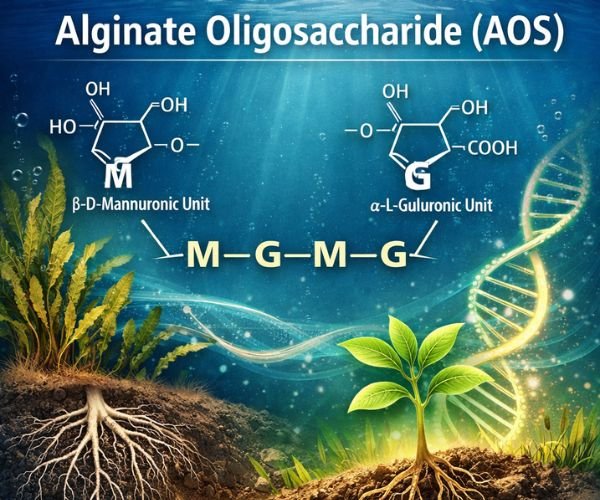
Alginate oligosaccharide (AOS) is a seaweed-derived biostimulant widely used in modern crop nutrition and functional fertilizer formulations. With the global shift from traditional fertilizers to efficiency-driven agricultural inputs, AOS has gained increasing attention for its clear mechanism of action, low effective dosage, and excellent compatibility in fertilizer systems
1. What Is Alginate Oligosaccharide?
Alginate oligosaccharide is a low-molecular-weight oligosaccharide derived from brown algae. It is composed of linear oligomers of β-D-mannuronic acid (M) and α-L-guluronic acid (G), with a typical degree of polymerization (DP) between 2 and 10.
Physically, AOS appears as a light yellow to brown powder, fully soluble in water and non-viscous after dissolution. Unlike alginate polymers, AOS does not thicken or gel, making it suitable for use in liquid and solid fertilizer formulations.
It is important to distinguish AOS from related seaweed-derived materials:
- Alginic acid: A high-molecular-weight natural polysaccharide found in brown algae, mainly used for thickening, gel formation, and film-forming applications.
- Seaweed extract: A broad category of water-soluble compounds obtained from brown algae, including oligosaccharides, fucoidan, laminarin, polyphenols, mannitol, betaine, and trace plant hormones.
- Alginate oligosaccharide (AOS): A specific, biologically active fraction obtained by controlled degradation of alginate.
2. Why Processing Technology Determines AOS Activity
Not all alginate oligosaccharides show the same biological performance. The production process is the decisive factor.
2.1 Enzymatic Hydrolysis vs. Chemical Degradation
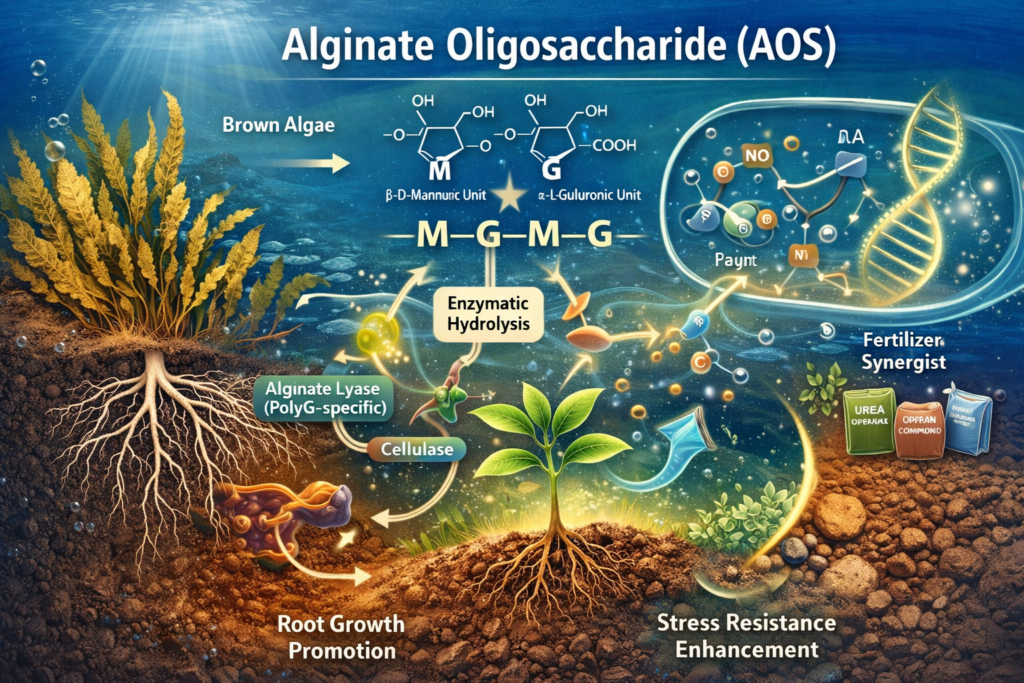
High-quality AOS is produced through pure enzymatic hydrolysis using alginate lyase. During this reaction, unsaturated double bonds are formed in the oligosaccharide chain. These unsaturated structures are considered the fundamental source of biological activity.
In contrast, chemically degraded alginate may achieve similar molecular size reduction but typically destroys these functional structures. As a result, chemically produced AOS often shows very limited or no physiological activity in plants.
2.2 PolyG-Specific Degradation
Alginate consists of polyM and polyG blocks. PolyG segments have a strong tendency to bind metal ions and form gels, which can negatively affect formulation compatibility.
By using PolyG-specific enzymatic degradation, Wellyou Tech AOS: – Reduces gel-forming behavior – Improves compatibility with nutrients and micronutrients – Enhances formulation stability in compound and water-soluble fertilizers
This approach improves not only biological performance but also practical formulation usability.
3. Molecular Characteristics of High-Performance
Alginate Oligosaccharide
Scientific studies indicate that alginate oligosaccharides with a lower degree of polymerization exhibit stronger biological effects.
Wellyou Tech AOS features: – Degree of polymerization: 2–5 – Molecular weight: 400–1000 Da – High water solubility and rapid plant response
Literature reports show that AOS with DP < 5 has a more pronounced effect on root growth and salt stress tolerance, making it particularly suitable for early-stage crop development and stress-prone environments.
4. Mechanism of Action in Plants
Alginate oligosaccharide functions primarily as a plant signaling molecule, not as a nutrient.
After binding to receptor proteins on the plant cell surface, AOS triggers: – Rapid accumulation of nitric oxide (NO) – Promotion of endogenous indole-3-acetic acid (IAA) synthesis
This signaling response is fast and can be completed within a few hours, explaining why AOS is consistently associated with root initiation and early growth activation.
5. Agronomic Effects of Alginate Oligosaccharide
Based on its signaling function, AOS delivers several agronomically relevant benefits:
5.1 Growth Promotion and Yield Improvement
- Faster rooting and sprouting
- Enhanced vegetative growth
- Improved fertilizer use efficiency, especially ammonium nitrogen
5.2 Enhanced Stress Resistance
As a signaling molecule, AOS activates key defense pathways, including: – Jasmonic acid (JA) pathway – Salicylic acid (SA) pathway
This improves crop tolerance to salinity and other abiotic stresses.
5.3 Synergistic Effects in Fertilizer and Crop Protection Programs
AOS enhances the performance of fertilizers and agrochemicals by: – Increasing nutrient uptake efficiency – Reducing fertilizer and pesticide dosage – Lowering the risk of phytotoxicity
6. Recommended Application Rates of Alginate Oligosaccharide
Correct dosage is critical for achieving consistent results. Excessive application does not improve performance and may lead to inhibitory effects.
Typical recommendations include:
- Soil drench / fertigation: 5–10 g per mu (higher rates in orchards)
- Foliar application: 0.3–0.5 g per 15 kg water
As a formulation synergist:
- Urea and compound fertilizers: 0.4–1 kg per ton
- Water-soluble fertilizers: 1–2 kg per ton
- Foliar fertilizers: 5–10 kg per ton
7. From Raw Material to Agronomic Solution
Alginate oligosaccharide is not a stand-alone solution. Its real value lies in correct processing, precise formulation, and proper application guidance.
At Wellyou Tech, AOS is developed not merely as a raw material, but as part of an integrated biostimulant solution designed to support efficient, sustainable, and performance-driven agriculture.
About Wellyou Tech
Wellyou Tech specializes in seaweed-derived biostimulants and functional fertilizer ingredients, focusing on enzymatic processing technologies and formulation compatibility to deliver consistent field performance.