
In modern agriculture, fertilizer efficiency is no longer defined by how much nutrient is applied—but by how much the crop can actually absorb. Traditional fertilizers often achieve less than 30% nutrient use efficiency, meaning most nutrients are lost through volatilization, leaching, or soil fixation.
Specialty fertilizers are rewriting this equation.
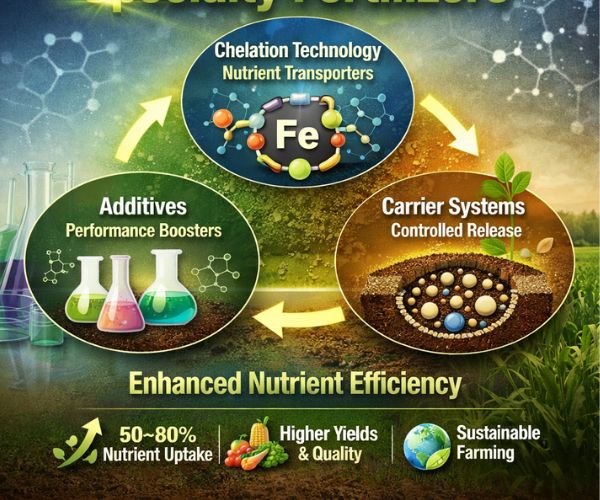
Their efficiency comes from the synergy of three core technologies:
- Additives – the “catalysts” that improve nutrient performance
- Chelation technology – the “transporters” that deliver micronutrients directly to plant roots
- Carrier technology – the “highway system” that controls nutrient release and positioning
Together, these technologies can increase nutrient utilization to 50–80% or higher, driving crop quality, yield and sustainability.
This article provides an in-depth overview of the scientific foundation behind specialty fertilizer enhancement—designed for global distributors, agronomists and growers seeking reliable, high-performance fertilizer solutions.
1. Additives: The Catalysts That Unlock Nutrient Efficiency
Additives are functional substances incorporated into fertilizers to improve physical properties, enhance nutrient stability, activate plant physiology, or provide additional agronomic benefits. Although they do not supply nutrients directly, they significantly amplify fertilizer effectiveness.
1.1 Stabilizers: Controlling Nitrogen Transformations
Nitrogen is highly prone to losses. Stabilizers slow down nitrogen conversion in soil, reducing volatilization and leaching.
- Urease inhibitors (e.g., NBPT): Delay urea hydrolysis, reducing ammonia volatilization.
- Nitrification inhibitors (e.g., DMPP, DCD): Inhibit nitrifying bacteria, keeping nitrogen in ammonium form longer and preventing nitrate leaching.
1.2 Biostimulants: The Biological Engine of Plant Growth
Biostimulants act on plant metabolism, improving root development, stress tolerance, and nutrient uptake.
- Humic/Fulvic acids: Improve soil structure and stimulate root elongation.
- Seaweed extract: Contains natural hormones and polysaccharides, enhancing stress resistance.
- Amino acids: Readily absorbed and support protein synthesis and metabolic regulation.
- Polyglutamic Acid (γ-PGA): Strong water-retention polymer forming a “nutrient reservoir” in the rhizosphere.
1.3 Microbial inoculants: Activating the Soil Ecosystem
Beneficial microbes such as Bacillus, phosphorus-solubilizing bacteria, and potassium-releasing bacteria colonize the rhizosphere and:
- release organic acids to mobilize P & K
- suppress soil-borne pathogens
- improve soil vitality and nutrient availability
1.4 Functional additives and surfactants
These improve fertilizer handling and compatibility.
- Anti-caking agents: Prevent moisture-induced caking and maintain free-flowing granules.
- Tank-mix enhancers: Improve spray adhesion, spreading, and stability in foliar applications.
2. Chelation Technology: Ensuring Micronutrients Reach the Plant
Micronutrients such as Fe, Zn, Mn, and Cu are easily fixed in soil, making them unavailable to plants. Chelation solves this problem by forming stable, water-soluble complexes that protect nutrient ions until they reach the root surface.
2.1 Main Types of Chelating Agents
Chemical Chelates
- EDTA, DTPA, EDDHA
High stability and strong chelation ability.
EDDHA-Fe is especially effective in calcareous soils.
Organic Acid & Amino Acid Chelates
- Citric acid, amino acids
Biodegradable, plant-friendly, and improve micronutrient absorption while supplying organic nitrogen.
Sugar Alcohol Chelates
- Sorbitol, mannitol
Low molecular weight, highly mobile in phloem—excellent for foliar feeding.
Next-Generation Green Chelates
- PASP, IDS/GLDA
Biodegradable, high-efficiency, and environmentally responsible—represent the future of chelation technology.
2.2 Advantages of Chelated Fertilizers
- 2–5× higher foliar absorption efficiency compared with inorganic salts
- 50–80% nutrient utilization in soil applications
- Excellent compatibility with fertilizers and pesticides
- Longer-lasting effects due to slow release and reduced fixation
- Reliable correction of micronutrient deficiency—e.g., EDDHA-Fe rapidly reverses iron chlorosis with up to 80% greening rate within 7 days
3. Carrier Technology: Precision Delivery for Maximum Impact
Carrier technology influences how nutrients are stored, protected, transported, and released in soil. It is the cornerstone of controlled-release and smart fertilizers.
3.1 Physical Carriers
Coated Slow/Controlled-Release Materials
- Polymer coatings (resin, sulfur)
- Compound matrix structures
Provide synchronized nutrient release aligned with crop demand, reducing applications and losses.
Adsorption Carriers
- Zeolite, bentonite, attapulgite
- Biochar, straw-based carbon materials
Highly porous structures adsorb nutrients, improve soil water retention, and reduce leaching.
3.2 Chemical Carriers
- Synthetic polymers (PAM, PVA): Water retention and slow-release backbone
- Modified natural materials (starch, cellulose, chitosan): Biodegradable eco-friendly carriers
3.3 Biological Carriers
Used for microbial fertilizers and biostimulants.
- Alginate, gelatin, microbial encapsulation materials
Protect active microorganisms from UV light, high temperature, and soil stress while ensuring targeted root colonization.
4. The Future: Integrated, Sustainable, and Intelligent Fertilizers
The new era of specialty fertilizers prioritizes green materials, higher precision, and system-level solutions.
Trend 1: Eco-Friendly & Precision-Tailored Formulations
Biodegradable chelates (IDS, PASP) and biodegradable carriers are becoming mainstream.
Customized formulations for specific soils, climates, and crops will define competitiveness.
Trend 2: Smart & Sensor-Integrated Fertilizers
Intelligent coating materials combined with soil moisture sensors and nutrient models will enable:
- on-demand nutrient release
- continuous precision feeding
- data-driven fertilizer management
Trend 3: From Products to Total Crop Solutions
Future market competition will come from scenario-based solutions, such as:
- fertigation-ready nutrient solutions
- drone-spraying compatible fertilizers
- crop-specific integrated nutrition programs
Specialty fertilizer technology is shifting agriculture from extensive input to intelligent nutrition management, ensuring higher yield, better quality, and more sustainable production.
The “efficiency revolution” of specialty fertilizers lies in the synergy between additives, chelation technology, and advanced carriers. These innovations transform nutrient delivery from a simple supply process into a high-precision, smart, and environmentally responsible system.
By understanding these core technologies, agricultural professionals can select better products, optimize fertilizer strategies, and ultimately help growers achieve higher returns from every kilogram of fertilizer applied.