
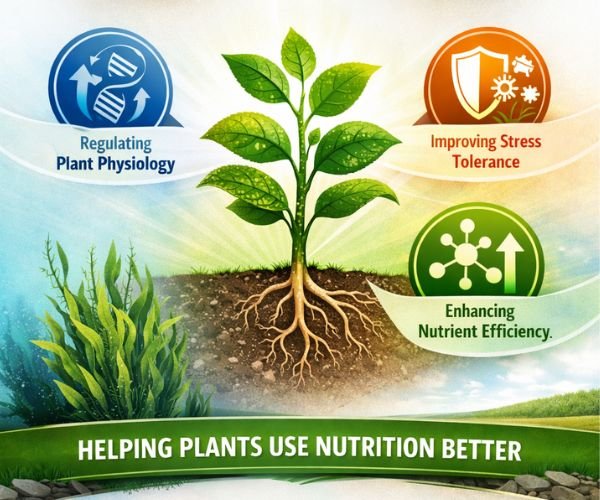
Seaweed extract is widely used in modern agriculture and increasingly categorized as a biostimulant rather than a nutrient input. However, its mode of action is often oversimplified or misunderstood, frequently reduced to claims of plant hormone content. This article provides a mechanism-based technical analysis of seaweed extract, focusing on its true biological role as a regulator of plant physiological processes. Emphasis is placed on signaling modulation, stress-response activation, and metabolic coordination, offering a scientific framework for evaluating and applying seaweed extract in commercial crop production.
1. Introduction: Repositioning Seaweed Extract
In many agricultural markets, seaweed extract has long been promoted as a “natural growth enhancer” or even a substitute for plant hormones. While such positioning may be commercially attractive, it fails to reflect the real agronomic value of the product.
From a technical standpoint, seaweed extract should be understood as a biostimulant: a material that enhances plant performance by regulating physiological processes rather than supplying nutrients or directly forcing growth responses.
Correct positioning is not semantic—it determines how the product is evaluated, formulated, and applied in the field.
2. The Misconception of Hormone-Centric Evaluation
One of the most common technical misunderstandings surrounding seaweed extract is the focus on plant hormone content, such as auxins, cytokinins, or gibberellins.
In practice: – Hormone concentrations in most commercial seaweed extracts are low and variable – Externally applied hormones alone rarely explain consistent field performance – Overreliance on hormone metrics can lead to unstable or exaggerated growth responses
Effective seaweed extracts do not function as hormone replacements. Instead, they act upstream, influencing how plants perceive, regulate, and respond to internal and external signals.
3. Core Action Mechanisms of Seaweed Extract
The agronomic value of seaweed extract lies in its multi-pathway physiological regulation. Key mechanisms include:
3.1 Signal Modulation and Stress Response Activation
Seaweed extracts contain biologically active oligosaccharides and low-molecular-weight polysaccharide fragments that act as signaling molecules. These compounds can: – Activate plant stress-response pathways – Enhance antioxidant enzyme systems – Improve cellular resilience under abiotic stress conditions
Rather than triggering growth directly, these signals prepare plants to respond more efficiently to environmental challenges.
3.2 Metabolic Coordination and Energy Efficiency
Under stress conditions, plants often experience metabolic imbalance, leading to reduced photosynthetic efficiency and nutrient utilization.
Seaweed extract supports: – Improved coordination between carbon and nitrogen metabolism – Stabilization of photosynthetic activity – More efficient allocation of assimilates between vegetative and reproductive organs
This explains why yield stability, rather than excessive vegetative growth, is often the most consistent benefit observed.
3.3 Root–Shoot Communication Enhancement
Root-derived signals play a critical role in regulating shoot development, especially under limiting conditions.
Seaweed-derived bioactive compounds have been shown to: – Stimulate root activity and architecture – Improve nutrient and water uptake capacity – Enhance root–shoot signaling efficiency
This systemic effect is essential for consistent performance across different crops and soils.
4. Why Synergy Matters More Than Single Components
No single compound in seaweed extract explains its full biological activity. Performance arises from the synergistic interaction of multiple components, including: – Oligosaccharides – Polysaccharides – Organic acids and naturally chelated micronutrients
Isolating or overemphasizing one fraction often reduces overall effectiveness. This is why well-designed seaweed extracts focus on preserving functional diversity rather than maximizing individual analytical values.
5. Implications for Formulation and Application
Understanding the mechanism of action has direct practical implications:
- Formulation designshould prioritize stability and compatibility, ensuring bioactive components remain functional in complex nutrient programs
- Application timingshould target physiological transition or stress-prone stages rather than periods of unrestricted growth
- Performance evaluationshould focus on stress tolerance, recovery speed, and yield stability, not short-term visual effects
Seaweed extract delivers its greatest value when used as part of an integrated crop management strategy.
6. Conclusion
Seaweed extract is not a shortcut to growth, nor a replacement for sound nutrition. Its true role is to support plant physiology through signal modulation, metabolic coordination, and stress-response enhancement.
When evaluated and applied based on mechanism rather than marketing claims, seaweed extract becomes a reliable agronomic tool—capable of delivering consistent, scalable benefits across crops and production systems.
In biostimulant science, effectiveness begins not with what is claimed on the label, but with how well the product aligns with plant biology.