
1. Product Overview
S-ABA (S-Abscisic Acid) is a naturally occurring plant hormone widely present in all green plants. It is a high-purity and high-biological-activity plant growth substance produced through advanced microbial fermentation technology.
It is non-toxic, non-irritating, and environmentally friendly, making it a safe and sustainable solution for modern agriculture. As a new-generation natural bio-active compound, S-ABA plays a crucial role in regulating plant growth, development, and stress responses.
2. Biological Function and Mode of Action
S-ABA is one of the most important phytohormones involved in plant physiological regulation. It functions mainly by:
- Integrating multiple environmental stress signals
- Regulating downstream stress-response pathways
- Balancing plant growth and reproductive development
Through precise physiological regulation, it helps plants adapt to adverse conditions while maintaining yield and quality.
3. Key Agronomic Benefits of S-ABA
3.1 Fruit Ripening and Quality Enhancement
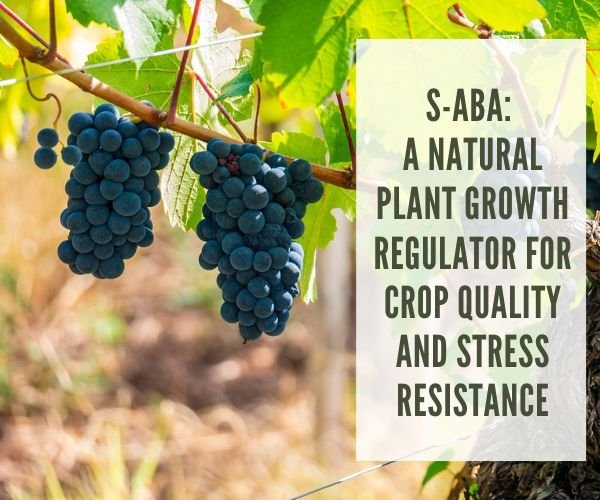
S-ABA significantly promotes fruit ripening and coloration, especially in grapes and berry crops. It increases:
- Reducing sugar content
- Soluble solids (Brix)
- Uniform coloration and market appearance
This allows fruits to reach market standards earlier with improved commercial value.
3.2 Yield and Dry Matter Accumulation
During the filling stage of major crops such as rice, wheat, and corn, S-ABA enhances dry matter accumulation, contributing to:
- Improved grain quality
- Higher thousand-grain weight
- More stable yield performance
3.3 Root Development and Vegetative Growth
Applied at early growth stages, S-ABA:
- Promotes root initiation and elongation
- Improves nutrient and water uptake
- Enhances seedling vigor and transplant survival
3.4 Stress Resistance and Growth Balance
S-ABA helps crops cope with environmental stresses such as drought, temperature fluctuations, and nutrient imbalance. When used in combination with fertilizers, it improves nutrient absorption efficiency and overall crop resilience.
3.5 Compatibility with Other Plant Growth Regulators
When properly formulated, S-ABA can be combined with other plant growth regulators to:
- Correct abnormal fruit growth
- Reduce deformity, cavity formation, and fruit cracking
- Improve overall fruit uniformity
4. Recommended Application Guidelines of S-ABA
4.1 Crop-Specific Applications
Rice
Seed treatment stage:
- Concentration: 0.3–0.4 ppm
- Method: Seed soaking
- Effect: Improves transplant survival rate
Seedling stage:
- Concentration: 1–2 ppm
- Method: Foliar spray
- Effect: Promotes tillering
Cotton / Peanut
Seedling stage:
- Concentration: 1.5–2.5 ppm
- Method: Foliar spray
- Effect: Increases yield potential
Vegetables
Seedling stage:
- Concentration: 2.5–10 ppm
- Method: Foliar spray
- Effect: Promotes root growth and flowering
After transplanting:
- Concentration: 2 ppm
- Method: Fertigation
- Effect: Enhances rooting and flower number
Fruit Crops
Budding stage:
- Concentration: 2.5–10 ppm
- Method: Foliar spray
- Effect: Improves flowering and fruit setting
Grapes
Veraison stage:
- Concentration: 100–400 ppm
- Method: Fruit spray
- Effect: Enhances coloration, improves quality, and accelerates market entry
5. Application of S-ABA with Fertilizers
S-ABA can be incorporated into compound fertilizer programs:
Fertigation:
- Concentration: 1–2 ppm
- Effect: Improves absorption of N, P, K, Ca, and Mg
Foliar Spray:
- Concentration: 10–20 ppm
- Effect: Enhances crop stress resistance and nutrient efficiency
6. Compatibility and Safety Notes
- S-ABA must not be mixed with alkaline pesticides
- Always conduct small-scale field trials before large-scale application
- Adjust dosage according to crop variety, climate, and local agronomic practices
S-ABA is a naturally derived and highly effective plant growth regulator that plays a key role in improving crop quality, regulating growth processes, and enhancing stress resistance. Through precise physiological control, S-ABA supports balanced vegetative and reproductive development across a wide range of crops.
When applied at appropriate growth stages and dosages, S-ABA contributes to improved fruit coloration and ripening, stronger root development, higher dry matter accumulation, and more efficient nutrient utilization. Its compatibility with fertilizer programs further enhances overall crop performance and sustainability.
As a modern, environmentally friendly bioactive solution, S-ABA offers growers and agribusiness partners a reliable tool for achieving stable yields, superior crop quality, and improved market competitiveness.