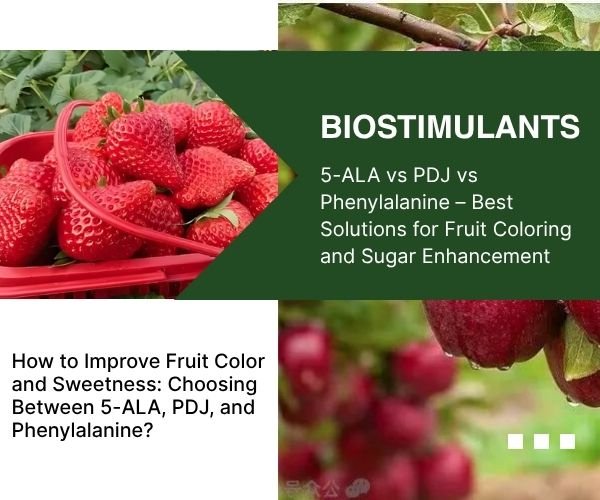
Fruit color is one of the most critical quality indicators in commercial fruit production. It directly affects market value, consumer preference, and harvest timing.
While traditional regulators such as ethephon can accelerate ripening, they often bring unwanted side effects like fruit softening, cracking, and premature senescence.
Today, safer and more targeted solutions—5-ALA (5-Aminolevulinic Acid), PDJ (Prohydrojasmon), and Phenylalanine—are increasingly used by professional growers.
But how do they differ, and which one should you choose?
Shared Benefits: Safer and More Efficient Alternatives
Before comparing their differences, it is important to understand why these three compounds are gaining popularity:
1. High Safety Profile
- Minimal risk of fruit cracking or early aging
- Gentle on plant physiology
- Suitable for high-value crops and export markets
2. Dual Function: Color + Sugar Enhancement
- Promote pigment synthesis (anthocyanins, carotenoids)
- Improve sugar accumulation
- Support earlier and more uniform ripening
Key Differences: Mechanism and Field Application
Although all three improve fruit coloration, their working mechanisms and best-use scenarios differ significantly.
1. PDJ – A Precise Coloration Accelerator
Mechanism
PDJ functions as a signaling activator. It stimulates the jasmonic acid pathway, which in turn enhances the synthesis of endogenous hormones such as:
- Ethylene
- Abscisic acid (ABA)
These hormones directly trigger:
- Anthocyanin accumulation (red/purple pigments)
- Carotenoid synthesis (yellow/orange pigments)
Application Characteristics
- Best timing: Color break stage (~20–30% coloration)
- Effect: Fast and visible improvement in color
- Frequency: 1–2 applications, 7–10 days interval
- Result: Harvest advanced by 7–10 days
Best Use Scenario
- High-value fruit production
- Late-stage coloration management
- Growers targeting premium market appearance
2. 5-ALA – The Metabolic Engine for Quality Improvement
Mechanism
5-ALA is a precursor of chlorophyll biosynthesis. It enhances:
- Photosynthetic efficiency
- Energy production
- Carbon assimilation
This leads to:
- Higher sugar accumulation
- Increased anthocyanin synthesis (indirectly)
In essence, 5-ALA improves the “source strength”, providing the raw energy needed for both sweetness and coloration.
Application Characteristics
- Flexible timing: Fruit expansion to coloration stage
- Application methods: Foliar spray + fertigation
- Core benefit: Long-term improvement in plant vitality
Best Use Scenario
- Low-light or cloudy regions
- Crops with weak photosynthesis
- Growers focusing on both yield and quality
3. Phenylalanine – The Building Block of Pigments
Mechanism
Phenylalanine is a key substrate in the phenylpropanoid pathway, leading to:
- Anthocyanin synthesis
- Flavonoid production
It provides the raw materials required for pigment formation.
Application Characteristics
- Effect: Mild and gradual
- Dependency: Strongly influenced by variety and environment
- Performance: Limited when used alone
Best Use Scenario
- As a supporting nutrient
- Combined with other biostimulants (e.g., 5-ALA)
- For balanced nutritional programs
Which One Is the Best Choice?
There is no single “best” solution—only the most suitable strategy based on your production goals.
For Rapid Color Development
→ Choose PDJ
Fast, targeted, and highly effective during the critical coloration stage
For Overall Quality and Sugar Enhancement
→ Choose 5-ALA
Improves plant metabolism, ensuring both sweetness and color
For Nutritional Support
→ Use Phenylalanine
Best as a complementary component rather than a standalone solution
Recommended Strategy: Combining Strengths for Maximum Results
In modern precision agriculture, combining these tools often delivers the best outcome:
- Early to mid stage: Apply 5-ALA to enhance photosynthesis and sugar accumulation
- Coloration stage: Apply PDJ to accelerate pigment formation
- Support: Add phenylalanine as a metabolic precursor
Result
- Improved fruit coloration
- Higher sugar content
- More uniform ripening
- Better market value
Conclusion
5-ALA, PDJ, and phenylalanine each play a unique role in fruit development:
- PDJ drives rapid coloration
- 5-ALA builds metabolic strength
- Phenylalanine supplies essential precursors
By understanding their mechanisms and applying them strategically, growers can achieve a balanced combination of color, sweetness, and yield—without the risks associated with traditional hormones.