
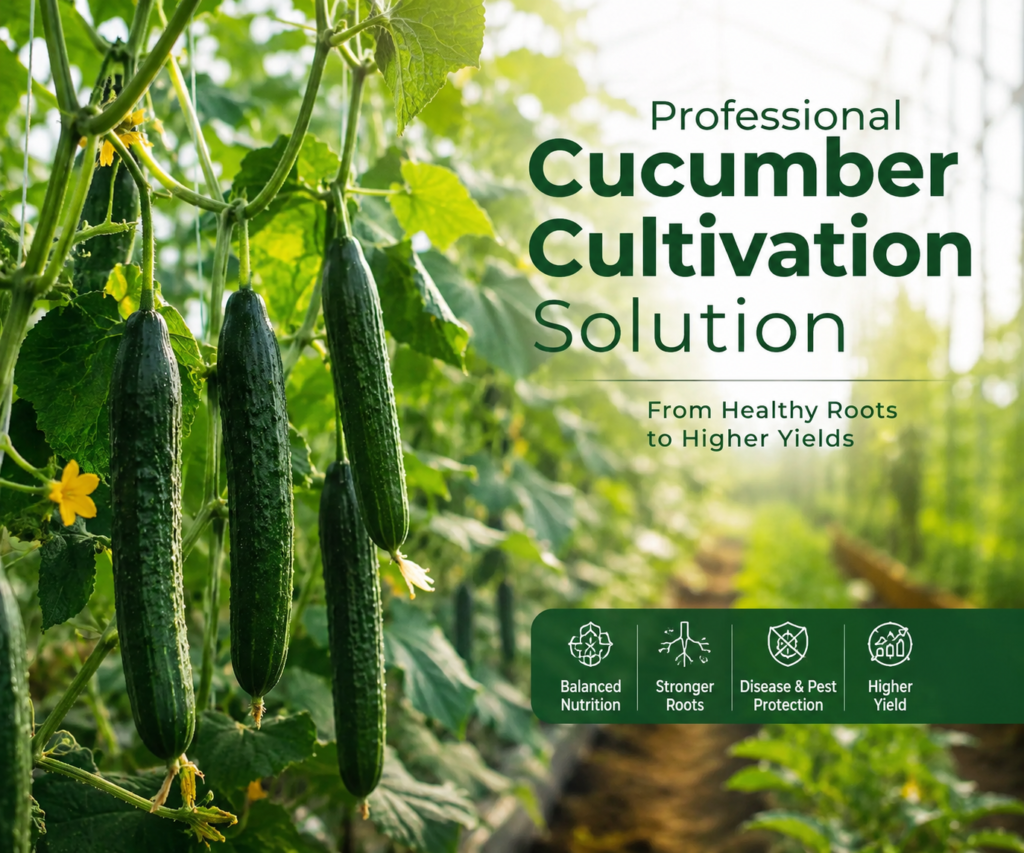
Cucumber cultivation requires more than basic fertilization and irrigation. Achieving stable yields, high-quality fruits, and long harvesting periods depends on a scientific approach combining nutrient management, disease prevention, environmental control, and root-zone optimization throughout the crop cycle. This article provides a comprehensive solution for cucumber cultivation, covering growth characteristics, nutrient demand, common pests and diseases, physiological disorders, and stage-specific fertilization strategies.
1. Understanding Cucumber Growth Characteristics
Plant Overview
Cucumber (Cucumis sativus L.) is a shallow-rooted climbing vegetable with rapid growth and high nutrient demand. Common commercial types include:
- Spiny cucumber – smooth, shiny fruit with fine spines; dominates ~80% of domestic markets.
- Field cucumber – spine-free, suitable for open-field cultivation.
- Dutch cucumber – high-quality fruit for fresh markets.
- Miniature and specialty cucumbers – compact varieties for niche markets.
Plant Structure
- Roots: Primary, lateral, adventitious, and fine root hairs; shallow and sensitive to drought and salinity.
- Stem: Vine-type growth with tendrils after 4 nodes; trellis support required.
- Leaves: Large, broad leaves; leaf removal at the base improves airflow.
- Flowers: Monoecious with separate male and female flowers.
- Fruits: Rapid expansion after fruit set; require continuous nutrient supply.
2. Growth Stages and Management Priorities
| Stage | Duration | Key Management |
|---|---|---|
| Germination | 5–7 days | Maintain high humidity and adequate light; prevent elongated seedlings; ensure uniform emergence. |
| Seedling | ~30 days | Promote root development, balanced vegetative growth, stress resistance. Apply rooting biostimulants. |
| Flowering | ~20 days | Transition to reproductive growth. Apply boron, calcium, seaweed extract, and brassinosteroids. Prevent flower abortion. |
| Fruiting & Harvest | Variable | Peak nutrient and water demand. Apply high-potassium fertilizers and foliar nutrients to ensure fruit size and quality. |
Environmental Requirements:
- Temperature: Optimal 13–32°C; ideal 24°C.
- Light: Short-day (8–11h) conditions favor female flowers.
- Water: Soil moisture 60–70% at seedling stage, 80–90% during fruiting. Avoid drought or overwatering.
- Soil: Fertile, well-aerated sandy loam; pH ~6.5.
- Nutrients: Highest demand for potassium, followed by nitrogen, calcium, phosphorus, magnesium. Nutrient uptake peaks during fruiting stages.
3. Common Pests and Diseases
Cucumbers are susceptible to fungal, bacterial, viral, and physiological disorders at various growth stages.
3.1 Fungal Diseases
| Disease | Symptoms | Control Measures |
|---|---|---|
| Damping-off | Seedling collapse | Apply 30% Mefenoxam·Metalaxyl 1500×, soil drench or spray. |
| Gray Mold | Gray fuzzy mold on leaves and fruits | Apply 38% Tebuconazole·Dimethomorph 40g, drench. |
| Powdery Mildew | White powdery spots on leaves | 42.4% Tebuconazole·Fluopyram 20ml, foliar spray. |
| Anthracnose | Dark lesions on fruits and leaves | 60% Tebuconazole·Dazomet 60g, foliar spray. |
| Fusarium Wilt | Wilting, yellowing leaves | 30% Mefenoxam·Metalaxyl 20ml + 30% Allicin 60ml, foliar spray. |
| Downy Mildew | Yellow angular spots, gray-purple mildew underneath | 70% Oxathiapiprolin·Cymoxanil 30g, foliar spray. |
| Sclerotinia (Stem Rot) | Soft rot at base of stem | 38% Tebuconazole·Dimethomorph 40g, foliar spray. |
3.2 Bacterial Diseases
| Disease | Symptoms | Control Measures |
|---|---|---|
| Angular Leaf Spot | Yellow lesions with brown centers | 33% Copper-Quinoline 40ml, foliar spray. |
| Bacterial Wilt | Sudden wilting, vascular browning | Soil fumigation, crop rotation, resistant varieties. |
| Bacterial Leaf Blight | Leaf necrosis and edge burn | 33% Copper-Quinoline or 3% Methyl Parathion, foliar spray. |
3.3 Viral Diseases
| Disease | Symptoms | Control Measures |
|---|---|---|
| Cucumber Mosaic Virus (CMV) | Mosaic leaves, stunted growth | Remove infected plants; control aphid vectors. |
| Zucchini Yellow Mosaic Virus (ZYMV) | Leaf deformation, yellowing, poor fruit set | Preventive foliar sprays with oligosaccharides 6%, 75g/acre. |
3.4 Insect Pests
| Pest | Symptoms/Impact | Control Measures |
|---|---|---|
| Whiteflies | Sap-sucking, transmit viruses | Ethyl-methyl-parathion, Flonicamid, foliar spray. |
| Aphids | Leaf curling, virus transmission | Pyrethroids, systemic insecticides. |
| Thrips | Leaf and fruit scarring | Insecticidal sprays. |
| Spider Mites | Yellowing, webbing | Abamectin, Fenpyroximate. |
| Caterpillars (Helicoverpa) | Leaf and fruit damage | Methomyl, Pyrethroids. |
3.5 Physiological Disorders
- Leaf Scorch: High temperature, low humidity, salt stress.
- Curved Fruits: Uneven water, poor pollination, nutrient imbalance.
- Bitter Fruits: Excess nitrogen, low potassium or phosphorus, drought stress.
- Flower Abortion: Low night temperatures, improper hormone use, nutrient deficiencies.
- Tip Necrosis & Leaf Curling: Boron and calcium deficiency; rapid soil drying.
Preventive measures include proper water management, nutrient balance, biostimulant applications, and careful pruning.
4. Nutrient Management Strategy
Cucumber fertilization should match growth stages for optimal yield.
| Growth Stage | Fertilizer Type | Method | Dosage | Benefits |
|---|---|---|---|---|
| Pre-planting | Organic fertilizer, 15-15-15 NPK, microbial inoculants | Soil incorporation | 50–5000 kg/acre | Improves soil structure, root development, balanced nutrition |
| Seedling & Early Growth | Humic acid K, seaweed extract, amino acids, chitosan | Fertigation / foliar | 2–5 L/acre | Enhances root growth, reduces transplant shock |
| Flowering & Fruit Set | Humic acid K, seaweed extract, boron, brassinosteroid | Foliar & fertigation | 1–5 L/acre | Supports flower differentiation, improves fruit set |
| Early Fruiting | Water-soluble NPK (20-20-20), “Water Supreme” (16-8-34) | Alternating fertigation | 5–10 kg/acre | Balanced nutrients, rapid fruit expansion, supplies Ca, Mg |
| Peak Fruiting | High-potassium fertilizer, balanced NPK | Alternating fertigation | 10 kg/acre | Supports high yield, ensures fruit size and quality |
| Late Fruiting | High-potassium fertilizer, boron-calcium foliar | Fertigation & foliar | 5 kg/acre | Delays senescence, reduces malformed fruits |
Practical Tips
- Maintain 20–30 cm spacing; trellis height 80–100 cm.
- Remove side shoots and tendrils when 8–10 cm long.
- Apply about 20 fertilization events during the crop cycle.
- Manage water carefully—avoid overwatering or drought stress.
- During high humidity or rainy days, delay pruning to prevent disease.
5. Root Management and Biostimulants
Biostimulant use throughout the crop cycle enhances:
- Root growth and vitality
- Nutrient uptake efficiency
- Stress tolerance (drought, cold)
- Fruit set and quality
Potassium fulvic acid and seaweed extract improve soil structure, chelate nutrients, and delay root aging.
6. Conclusion
Successful cucumber cultivation relies on integrated crop management:
- Healthy root system
- Balanced fertilization
- Proper irrigation
- Environmental regulation
- Disease prevention
- Strategic use of biostimulants
By following a stage-specific nutrient and pest management program, growers can achieve high yields, premium quality fruits, and sustainable production.
For professional cucumber cultivation solutions, biostimulants, and customized fertilizer programs, visit Wellyou Tech.