
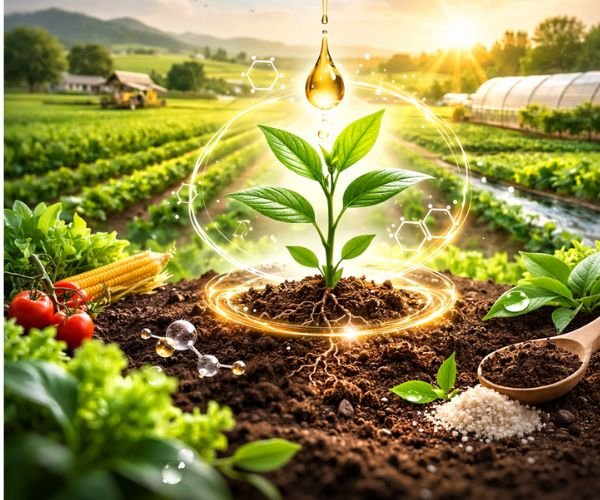
As global agriculture shifts toward greener, safer, and more sustainable production systems, bio-based agricultural inputs are rapidly becoming essential. Among these, chitosan oligosaccharide (COS)—a low-molecular-weight derivative produced from the degradation of natural chitin—has emerged as a highly effective, eco-friendly agricultural bio-stimulant. With advantages such as biodegradability, non-toxicity, and zero chemical residue, chitosan oligosaccharide plays a vital role in modern sustainable farming.
Today, farmers face increasing challenges: soil degradation, crop stress, disease pressure, and the demand for higher yields with fewer chemical inputs. COS provides an innovative solution by integrating crop protection, soil improvement, plant growth promotion, and quality enhancement into one clean technology.
Below is a comprehensive overview of its agricultural applications.
1. Natural Plant Protection of Chitosan oligosaccharide: Dual “Pesticide + Fertilizer” Function
COS and its derivatives serve as natural plant protectants with both bio-pesticide and bio-fertilizer properties. Their unique mechanism stimulates plant immune responses, enhances disease resistance, and helps plants defend themselves naturally against a wide range of pathogens.
Key benefits include:
- Inhibition of bacteria, fungi, and viruses
- Reduced incidence of major crop diseases
- Effective use in fruit trees, vegetables, tobacco, grains, and cotton
- Safer alternative to chemical pesticides
- Compliance with organic and green food production standards
By enhancing the plant’s own defense systems rather than relying on external chemical control, chitosan oligosaccharide supports long-term crop health and environmental sustainability.
2. Soil Improvement and Microbial Activation
Healthy soil is the foundation of high-quality agricultural production. Chitosan oligosaccharide contributes to soil recovery and fertility improvement by optimizing the soil micro-ecosystem.
How it works:
- Improves soil structure, aeration, and water-holding capacity
- Supports beneficial microorganisms while suppressing harmful ones
- Promotes nutrient availability and long-term soil vitality
With continuous application, soils become more resilient, biologically active, and capable of supporting stronger and healthier crops.
3. Plant Growth Promotion and Root Development
Chitosan oligosaccharide functions as a natural bio-stimulant, promoting both above-ground and below-ground plant growth.
Plant growth benefits:
- Enhances photosynthetic efficiency
- Stimulates root elongation and branching
- Improves nutrient absorption (N, P, K and micronutrients)
- Strengthens stress tolerance (salinity, drought, cold, and heat)
By boosting physiological activity, crops grow more vigorously and maintain better performance under challenging conditions.
4. Boosting Plant Immunity Through Systemic Activation
One of the most unique advantages of chitosan oligosaccharide is its ability to activate plant immunity. It acts as an elicitor, triggering the plant to produce disease-resistant proteins, enzymes, and secondary metabolites.
Immune-related effects include:
- Activation of systemic acquired resistance (SAR)
- Higher antioxidant capacity
- Reduced susceptibility to infections
- Lower disease incidence during critical growth stages
Instead of treating diseases after they occur, chitosan oligosaccharide encourages preventive protection.
5. High-Value Use of Chitosan Oligosaccharide in Organic Fertilizer Formulation
As an additive in organic fertilizers, chitosan oligosaccharide significantly enhances fertilizer quality and efficiency.
Advantages in fertilizer applications:
- Provides readily absorbable nutrients
- Enhances soil-plant nutrient cycling
- Reduces reliance on synthetic fertilizers
- Supports organic certification requirements
Its compatibility with organic farming systems makes it a preferred component in modern green agriculture inputs.
Why Chitosan Oligosaccharide Matters for the Future of Agriculture
With increasing global emphasis on sustainability, eco-friendly bio-stimulants like chitosan oligosaccharide are expected to play an even larger role in the agricultural industry. Its multi-functional properties—soil protection, crop strengthening, yield improvement, and residue-free safety—align perfectly with the development direction of future agriculture.
For farmers, distributors, and agricultural solution providers, adopting COS is not only a technological upgrade but also a commitment to responsible agricultural development.