
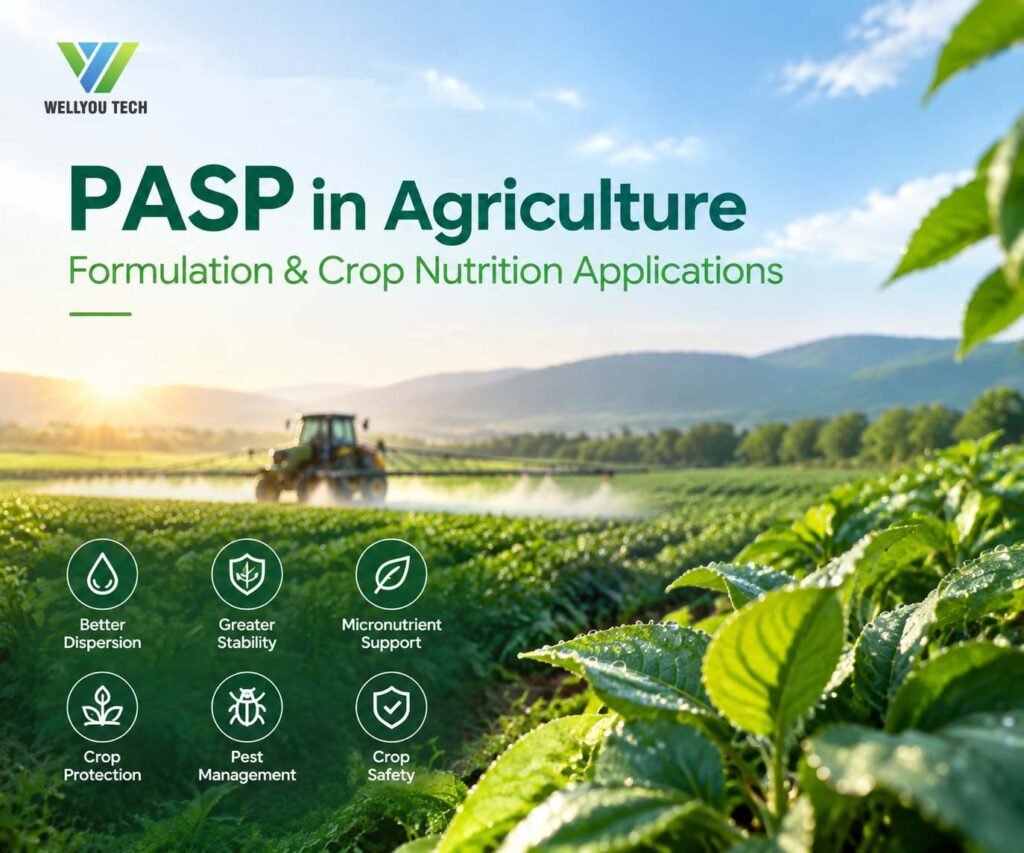
Polyaspartic acid (PASP) is a biodegradable polymer with metal-ion-binding and dispersing properties that make it interesting for agricultural formulations. Depending on its molecular characteristics, salt form, dosage, and formulation system, PASP may serve as a functional additive in crop protection products and crop nutrition solutions.
For agrochemical formulators and agricultural input manufacturers, PASP offers opportunities to explore formulation stability, micronutrient compatibility, and the performance of spray mixtures.
In this article, we explore six potential applications of PASP in agriculture, from wetting and dispersion to micronutrient delivery and crop safety.
What Is Polyaspartic Acid (PASP)?
Polyaspartic acid (PASP) is a synthetic biodegradable polymer derived from aspartic acid. Its functional groups enable it to interact with certain metal ions and influence particle dispersion in suitable aqueous systems.
In agriculture, PASP and its salts are investigated for applications in fertilizer formulations, micronutrient management, and agrochemical formulation development.
Its actual performance depends on factors such as molecular weight, degree of neutralization, concentration, water quality, pH, and compatibility with other formulation ingredients.
6 Potential Applications of PASP in Agriculture
1. Wetting and Dispersion Support
Uniform spray coverage is important for effective crop protection. Poor wetting or uneven dispersion may result in inconsistent distribution of active ingredients across plant surfaces.
PASP may contribute to dispersion and formulation stability in selected agrochemical systems. However, its ability to reduce surface tension and improve leaf wetting should be verified for each formulation.
For formulators, PASP can be evaluated alongside conventional wetting agents and dispersants to determine whether it improves spray coverage, suspension behavior, or application consistency.
Potential application: Development of selected aqueous agrochemical formulations and spray mixtures.
2. Metal-Ion Binding and Formulation Stability
Water quality can influence agrochemical performance. Calcium, magnesium, iron, and other metal ions may interact with certain active ingredients or formulation components, potentially causing precipitation, reduced solubility, or other compatibility problems.
PASP can bind certain metal ions under appropriate conditions. This property makes it worth evaluating as a functional additive in formulations where metal-ion interactions affect physical stability.
Nevertheless, metal-ion binding does not guarantee compatibility with every pesticide. Jar tests, stability testing, and active-ingredient compatibility assessments remain essential.
Potential application: Formulation development for systems sensitive to water hardness or metal-ion interactions.
3. Micronutrient Formulation and Crop Nutrition
PASP may also be investigated in crop nutrition products containing micronutrients such as iron, zinc, manganese, and copper.
Its interaction with metal ions may help influence their behavior in selected formulations. When combined with an appropriate micronutrient source, PASP may contribute to formulation design and nutrient management strategies.
The final performance depends on the metal source, pH, nutrient concentration, and chemical stability of the complete system. PASP should not automatically be considered a substitute for established chelating agents such as EDTA or EDDHA.
Potential application: Development of selected micronutrient fertilizers and combined crop nutrition solutions.
4. Supporting Weed Control and Crop Quality
PASP offers promising potential in agricultural applications beyond formulation optimization. When used in combination with glyphosate, it can be explored as a multifunctional additive in weed management programs.
Sugarcane provides an example of this application: the combination has been associated with weed control and the potential to increase sugar accumulation, offering an opportunity to improve both weed management and crop quality.
The potential applications of PASP are not limited to sugarcane. Depending on the crop, formulation, and application conditions, PASP may offer further opportunities to support crop quality and agricultural productivity.
Potential application: PASP-based formulation development for weed management and crop quality improvement.
5. Evaluation in Pest-Control Bait Formulations
In some pest-control applications, the feeding behavior of the target pest influences product performance. Bait formulations may therefore use ingredients designed to improve palatability or encourage feeding.
PASP has been proposed for evaluation in certain bait systems, but its effectiveness as a feeding attractant should not be assumed without experimental evidence.
For product developers, controlled feeding trials can help determine whether PASP provides a measurable benefit in a particular formulation.
Potential application: Research and development of selected pest-control bait formulations.
6. Crop Safety and Compatibility Testing
Some crop protection products can cause phytotoxicity under particular conditions. Crop sensitivity, application rate, weather, water quality, and tank-mix compatibility can all influence the risk.
PASP may be investigated as part of formulation optimization or tank-mix compatibility studies. However, it should not be regarded as a universal antidote to pesticide injury.
For products containing copper compounds, dithiocarbamate fungicides, or other potentially crop-sensitive ingredients, crop safety trials should be conducted before making claims about reduced phytotoxicity.
Potential application: Formulation screening and crop safety evaluation for selected agrochemical systems.
Wellyou Tech: PASP Solutions for Agricultural Applications
At Wellyou Tech, we focus on agricultural inputs and formulation solutions for fertilizer manufacturers, agrochemical companies, wholesalers, and distributors.
Our PASP product range can be considered for suitable formulation development projects, subject to product specifications and application requirements.
We understand that different markets and formulations require different technical solutions. Product selection should therefore be based on the intended use, required specifications, compatibility, and applicable regulatory requirements.
If you are developing an agrochemical formulation, micronutrient product, or other agricultural solution, our team can discuss your technical requirements and help identify a suitable PASP grade for evaluation.
Contact Wellyou Tech to discuss PASP specifications, sample availability, and potential applications in your agricultural formulation projects.
Frequently Asked Questions About PASP in Agriculture
What is PASP used for in agriculture?
Polyaspartic acid (PASP) is investigated for applications in fertilizer formulations, micronutrient systems, and selected agrochemical formulations. Potential functions include metal-ion binding and dispersion support, depending on the formulation.
Can PASP improve pesticide performance?
PASP may influence the physical properties or compatibility of certain agrochemical formulations. Any improvement in pesticide efficacy must be demonstrated through formulation testing and appropriate field trials.
Is PASP a chelating agent?
PASP can bind certain metal ions through interactions with its functional groups. Its binding behavior depends on pH, metal-ion type, concentration, and other formulation conditions. It should not be assumed to perform identically to EDTA, EDDHA, or other established chelating agents.
Can PASP be mixed with glyphosate?
Compatibility depends on the glyphosate formulation, PASP grade, water quality, concentrations, and other additives. Conduct compatibility and crop-safety testing before preparing or applying a tank mixture, and follow the product labels and local regulations.
How can I select a suitable PASP product?
Start by defining the intended application, formulation type, target specifications, and compatibility requirements. Review the supplier’s technical data and test the selected grade in the complete formulation before commercial use.
Looking for a PASP supplier for your agricultural formulation project? Contact Wellyou Tech to discuss your requirements.