
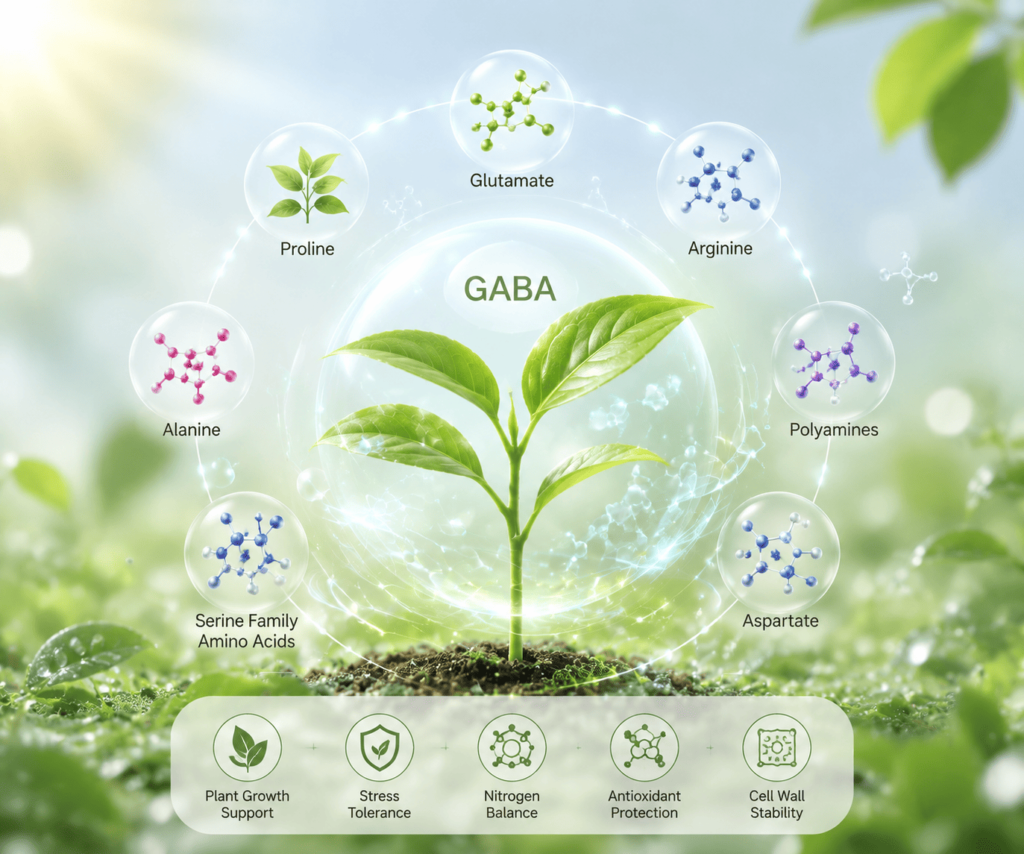
γ-Aminobutyric acid (GABA) is a non-protein amino acid widely distributed in plants and plays a central role in regulating growth, maintaining cellular homeostasis, and mediating responses to biotic and abiotic stresses. As both a metabolic intermediate and signaling molecule, GABA integrates with multiple amino acid metabolic pathways, forming a highly coordinated regulatory network that supports plant development and environmental adaptation.
This article systematically reviews the GABA metabolic pathway, its interaction with key amino acids, and the regulatory roles of the GABA–amino acid network in plant growth and stress responses. The aim is to provide a theoretical foundation for molecular breeding of stress-tolerant crops and sustainable agricultural regulation strategies.
1. Introduction: The Central Role of GABA in Plant Metabolism
γ-Aminobutyric acid (GABA) is present throughout plant development, from seed germination to fruit maturation. It accumulates rapidly under environmental stresses such as drought, salinity, extreme temperatures, flooding, heavy metal exposure, and pathogen infection, indicating its core role in plant stress adaptation.
γ-Aminobutyric Acid is primarily synthesized through the GABA shunt pathway, which directly links carbon and nitrogen metabolism. This pathway is essential for:
- Energy balance regulation
- Cellular pH stabilization
- Reactive oxygen species (ROS) detoxification
In addition, GABA interacts closely with multiple amino acid pathways, including glutamate, proline, polyamines, arginine, aspartate, and serine-family amino acids, forming a complex metabolic regulation network.
2. The GABA Metabolic Pathway and Its Functional Significance
γ-Aminobutyric Acid shunt bypasses parts of the tricarboxylic acid (TCA) cycle that are sensitive to oxidative stress, ensuring metabolic continuity under adverse conditions.
Key enzymes include:
- Glutamate decarboxylase (GAD)
- GABA transaminase (GABA-T)
- Succinic semialdehyde dehydrogenase (SSADH)
This pathway connects nitrogen assimilation with carbon flux, enabling plants to maintain metabolic stability during stress conditions such as salt stress or phosphorus deficiency.
3. Interaction Between GABA and Key Amino Acid Pathways
3.1 GABA–Glutamate–Glutamine Regulatory Module
Glutamate is the direct precursor of GABA and a central hub of nitrogen metabolism. It is involved in the synthesis of:
- Glutamine
- Proline
- Arginine
- Alanine
- Serine-family amino acids
It also serves as a precursor for chlorophyll, glutathione, polyamines, and ethylene biosynthesis.
Under stress conditions, glutamate is redirected toward γ-Aminobutyric Acid and proline synthesis to enhance osmotic adjustment and antioxidant capacity.
γ-Aminobutyric Acid further regulates glutamate and glutamine levels through feedback mechanisms and activates glutamine synthetase (GS), improving nitrogen assimilation and recycling.
Together, the GABA–glutamate–glutamine module acts as a core regulatory system for balancing growth and stress tolerance in plants.
3.2 GABA and Glutamate Receptor-Like Signaling (GLRs)
Glutamate receptor-like channels (GLRs) mediate Ca²⁺ influx and downstream signaling in plants. γ-Aminobutyric Acid competes with glutamate in regulating GLR activity, thereby influencing:
- Calcium signaling pathways
- Growth regulation
- Immune responses
This competitive interaction highlights GABA as a key signaling modulator beyond its metabolic role.
3.3 GABA and Proline Metabolism
Proline is a major osmoprotectant in plants under stress. It can be converted into GABA through polyamine degradation pathways, while γ-Aminobutyric Acid accumulation also influences proline metabolism.
This bidirectional regulation contributes to:
- Enhanced antioxidant defense
- Improved drought and salinity tolerance
- Stabilization of cellular redox balance
Polyamines derived from proline metabolism can also modulate GABA biosynthetic enzyme activity, further linking these pathways.
3.4 GABA and Aspartate Metabolism
γ-Aminobutyric Acid interacts with aspartate metabolism at multiple metabolic junctions. Under stress conditions, γ-Aminobutyric Acid accumulation can redirect aspartate flux, improving nitrogen use efficiency and supporting plant growth under nutrient-limited environments.
3.5 γ-Aminobutyric Acid and Polyamine–Ornithine Pathway
Polyamines increase significantly under stress and their degradation produces GABA. In return, GABA regulates polyamine metabolism and ROS homeostasis, forming a feedback loop that enhances tolerance to abiotic stress.
3.6 γ-Aminobutyric Acid and Serine Family Amino Acids
Serine and glycine influence GABA metabolism by regulating cellular redox states. In turn, GABA contributes to maintaining pH and energy balance, forming a cooperative system that stabilizes cellular metabolism under stress conditions.
3.7 GABA, Alanine, and Arginine Metabolism
- γ-Aminobutyric Acid can be converted into alanine via transamination, helping alleviate cytoplasmic acidification under hypoxia.
- Arginine, through polyamine biosynthesis, connects nitrogen metabolism with GABA pathways, supporting stress adaptation.
4. γ-Aminobutyric Acid in Plant Stress Physiology and Defense Responses
GABA accumulation is strongly associated with plant defense against:
- Drought stress
- Salinity stress
- Temperature extremes
- Flooding (hypoxia)
- Heavy metal toxicity
- Pathogen infection
Through modulation of ROS scavenging systems, ion homeostasis, and nitrogen metabolism, γ-Aminobutyric Acid plays a central role in maintaining physiological stability under stress conditions.
Recent studies also show that γ-Aminobutyric Acid contributes to:
- Cell wall stabilization under salinity and drought stress
- Improved nitrogen utilization efficiency
- Enhanced resistance to pests and pathogens
5. Amino Acid Regulation of γ-Aminobutyric Acid Biosynthesis
5.1 β-Aminobutyric Acid (BABA)
β-Aminobutyric acid (BABA), a structural isomer of GABA, activates plant defense pathways and enhances γ-Aminobutyric Acid and glutamate accumulation, improving disease resistance.
5.2 Serine–Glycine Metabolism
Serine and glycine regulate redox balance, indirectly influencing GABA biosynthesis. This interaction helps maintain cellular energy and pH homeostasis under stress.
5.3 Phenylalanine Pathway Interaction
Under salt and drought stress, γ-Aminobutyric Acid accumulation may influence phenylalanine metabolism, strengthening cell wall integrity and improving structural resistance.
6. Integrated Regulatory Network of GABA in Plants
γ-Aminobutyric Acid metabolism forms a complex interaction network with key amino acids such as:
- Glutamate
- Proline
- Phenylalanine
- Aspartate
- Arginine
- Serine family amino acids
This network regulates:
- Carbon–nitrogen balance
- Antioxidant capacity
- Cell wall stability
- Nitrogen use efficiency
- Stress signaling and adaptation
7. Conclusion and Application Prospects
γ-Aminobutyric Acid is a central metabolic and signaling molecule in plants, integrating multiple amino acid pathways into a coordinated regulatory network. Its interactions with glutamate, proline, aspartate, phenylalanine, and other amino acids enable plants to maintain metabolic stability and enhance stress tolerance under adverse environmental conditions.
This makes γ-Aminobutyric Acid highly valuable in:
- Molecular breeding for stress-resistant crops
- Development of biostimulants
- Sustainable agricultural regulation strategies
- Enhancing nutrient use efficiency and crop resilience
With increasing environmental challenges, the GABA–amino acid metabolic network represents a promising target for future agricultural innovation and green crop management systems.